AI Resume Tools 2026: 7 Picks That Actually Beat the ATS
98.8% of Fortune 500 firms use an ATS. These 7 AI resume tools beat it in 2026: Teal, Rezi, Jobscan and more, with real prices and a 30-minute workflow.
Arun Agarhari
Founder & Technical Systems Engineer
November 9, 2026 19 min read20.8k reads
Share
Job seeker reviewing a printed resume beside a laptop, AI resume tools 2026
Key Takeaways
The old story went like this: a bot scans your resume for keywords, rejects 75 percent automatically, and a human never sees it. That story is wrong.What actually happened is quieter and more important, and it changes which tools are worth your money.
Ninety-eight point eight percent of Fortune 500 companies run an applicant tracking system.
Seventy-nine percent of organizations have integrated AI or automation into that ATS.
The new layer does not just count keywords.
It ranks candidates by predicted fit using semantic matching, skill clustering, and behavioral signals from your work history.
Key numbers at a glance
of Fortune 500 companies run an applicant tracking system
of organizations have built AI or automation into that ATS
About of job applications now carry AI-generated content
of US HR leaders say AI applications slowed hiring, and report heavier workloads (Robert Half, March 2026)
of job seekers use AI in their search (Clutch, July 2026): edit resumes with it, write cover letters, apply to more jobs
of job seekers tailor their resume for each application; apply to 10 or more jobs before finding one
of resumes score below 50 out of 100 on ATS checks before optimization
of job-description keywords are missing from the average resume
of Fortune 500 companies do NOT auto-reject on keywords alone
Chatbot-only resumes passed ATS filters about of the time, versus about for a dedicated tool, in one 2026 head-to-head test
is the Rezi score to reach before exporting, after a 23-point audit covering keyword density, section order, date consistency, and parser readability.
is the Jobscan target on the match rate, and the free tier gives 5 scans per month, so use them on your top five applications each week.
: the story that bots automatically reject 75 percent of resumes came from a misunderstood 2012 study, and 92% of Fortune 500 companies do not auto-reject on keywords alone
: the free Resume Worded checker scores 30-plus criteria, from action verbs and quantifiable results to buzzword density and section completeness
: the workflow runs 5 minutes to target, 10 to tailor, 5 to score, 5 to parse-test, and 5 for a human glance before submitting
Last reviewed: November 2026.
How did hiring change in 2026?
What actually happened is quieter and more important, and it changes which tools are worth your money.
Ninety-eight point eight percent of Fortune 500 companies run an applicant tracking system. Seventy-nine percent of organizations have integrated AI or automation into that ATS. The new layer does not just count keywords. It ranks candidates by predicted fit using semantic matching, skill clustering, and behavioral signals from your work history. The bot reads your resume the way a recruiter would skim it, looking for evidence, not just vocabulary.
At the same time, job seekers flooded the pipe with AI-generated material. About seventy-eight percent of job applications now carry AI-generated content. A March 2026 https://marketwirenews.com/stock/rhi/news/robert-half-survey-67-of-hr-leaders-report-ai-genera-4726726453756075.html found sixty-seven percent of US HR leaders say AI-generated applications slowed hiring and eighty-four percent report heavier workloads. A July 2026 https://clutch.co/resources/state-ai-hiring found eighty percent of job seekers use AI in their search. Eighty-four percent use it to edit resumes, sixty-six percent for cover letters, and eighty-six percent apply to more jobs per week because of it. Ninety-four percent of job seekers tailor their resume for each application. Sixty-eight percent apply to at least ten jobs before finding one.
The volume went up. The signal went down. Recruiters now spend even less time per resume, and the hiring managers on the other side are drowning in applications that all sound the same. The winners are the ones who give the AI ranker what it actually looks for: concrete skills, measurable outcomes, and clean formatting that parses without errors. If you are just starting out, our guide to /blog/entry-level-job-crisis-2026 covers the entry-level side of the same squeeze.
What does the ATS actually look for now?
There is no single tripwire waiting to bin your resume. Instead, the system scores fit. It matches the skills in your resume against the skills in the job description, checks whether your work history backs up the skills you claim, and ranks you against every other applicant. A resume that clears the bar gets read by a person. A resume that scores low sinks, even if it has the right keywords sprinkled through it.
That is why the average resume is in trouble before it starts. Fifty-one percent of resumes score below 50 out of 100 on ATS checks before optimization, and the average resume misses fifty-two percent of the job-description keywords. The gap is not hard to close, but it takes real editing, not a new font. Mirror the language of the job description where it is true of you, put numbers next to your claims, and keep the format plain enough that a parser reads every section in order.
The ranker also cross-checks. If you list a skill but none of your bullets show you using it, the confidence score drops. So the skills that matter most are the ones you can prove with a project, a result, or a number. Our guide to /blog/build-ai-skills-that-pay-2026 shows which skills employers actually pay for and how to get proof of them fast. A short course with a finished project beats a long list of tools you have only read about.
Which AI resume tool should you pick?
Teal writes and tracks. Rezi scores. Jobscan checks the match against one specific posting. The table below compares all seven picks at a glance, and the notes after it explain how to use each one. Prices shift, so check the site before you commit.
AI resume tools compared
Tool
Best for
Price per month
Free tier
Teal
All-round writing plus application tracker
$9 to $19
Yes, generous
Rezi
Strict ATS scoring with 23-point audit
$29
Limited
Jobscan
Standalone match-rate scanner
About £40
5 free scans
Kickresume
Design-first templates that still parse
$19
Basic
Enhancv
Design-first with strong content guidance
$20
Basic
ChatGPT / Claude
Free writing help and ideas
Free / $20
Yes
Resume Worded
Scored health check and line-level feedback
$49
Limited
Teal, the all-rounder
Create a free account and import your LinkedIn profile or upload an existing resume. Open the resume builder, choose a clean template, and avoid columns, graphics, or text boxes. Paste a target job description into the matching panel and Teal highlights missing keywords and suggests where to add them. Write each bullet using the formula: action verb plus metric plus context. One example from a real marketing role: "Increased Meta Ads ROAS 32 percent in Q3 by restructuring campaign hierarchy and introducing creative testing protocol." Run the built-in ATS check, fix any red flags, usually missing section headers or non-standard date formats, then save the tailored version. Teal logs the application in your tracker with the job link, status, and follow-up date, which matters when you are juggling ten or more live applications.
Rezi, the strict scorer
Start a new resume and select the ATS-optimized template set. Fill every section, because Rezi forces you to complete skills, certifications, and projects before it scores. Paste the job description and Rezi runs a 23-point audit covering keyword density, section order, date consistency, and parser readability. Address every red item. The tool explains why each matters, for example "Missing 'project management' keyword appears 3 times in JD." When the score hits 85 or above, export as PDF. Then verify the PDF text layer by copying it into Notepad. If the text garbles, re-export. Rezi is the tool to use when you want a hard number before you hit send.
Jobscan, the match-rate specialist
Do not write in Jobscan. Write elsewhere, then come here to test. Paste your resume text and the job description into the two boxes and run the scan. You get a match rate percentage, a keyword list split into hard skills, soft skills, and job titles, and a formatting check. Add the missing high-frequency keywords naturally into your existing bullets. Do not stuff. Rescan and aim for 75 percent match or higher. The free tier gives five scans per month, so use them on your top five applications each week.
Kickresume, the design pick
Pick a template labeled "ATS-friendly." Most modern ones are. Import LinkedIn or start fresh. The AI writer suggests bullets based on your role, but treat suggestions as drafts and rewrite them with your numbers. Keep fonts standard, avoid icons in section headers, and use bold for emphasis only. Export the PDF, then run the file through a free parser like Careerflow or Resume Worded to confirm it reads clean. Kickresume suits people who care how the resume looks to a human reader as much as how it parses for the machine.
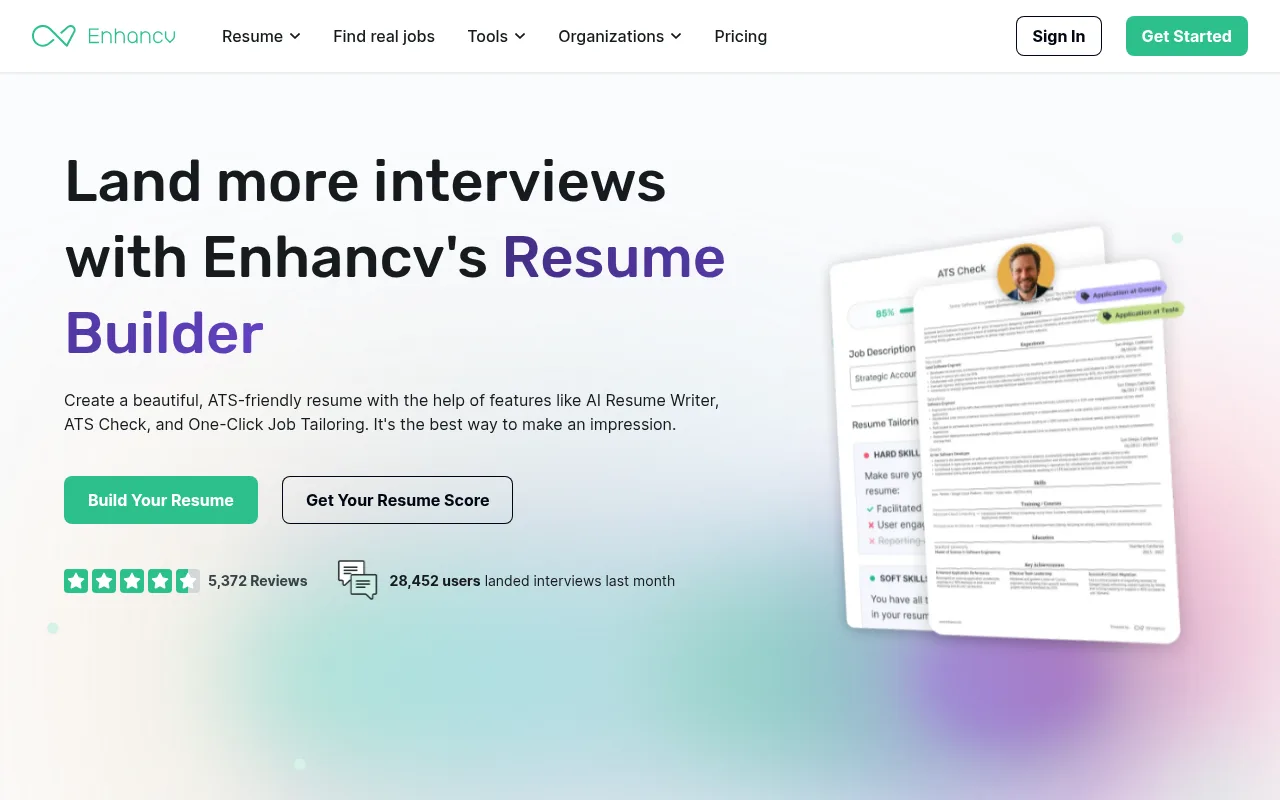
Enhancv, the guided design pick
Choose a template and the content analyzer flags vague bullets in real time. Use the "Tailor to Job" feature: paste the job description and Enhancv highlights gaps and suggests rewrites. The "Share for Feedback" link lets a mentor or friend comment inline, and you should use it, because a second pair of eyes catches the claims that sound good to you and empty to a stranger. Export and parse-test before applying. Enhancv is the best fit when you want the tool to coach the writing, not just score it.
ChatGPT and Claude, the free writing help
Paste your raw bullet and the target job description, then prompt with limits: "Rewrite this bullet for a Meta Ads manager role. Keep it under 20 words. Include a metric. Use past tense. No fluff." Iterate, ask for three variations, and pick the strongest. Do not ask the chatbot to write the whole resume. It invents dates, adds tools you never used, and produces generic phrasing that the AI ranker downweights. In a 2026 head-to-head test, a chatbot-only resume passed ATS filters about 29 percent of the time, versus about 71 percent for a dedicated tool. Use the chatbot for single bullets and ideas, then verify every claim against your actual work history.
Resume Worded, the health check
Upload your PDF or paste text, then run the "Score My Resume" audit. It checks 30 plus criteria: action verbs, quantifiable results, buzzword density, and section completeness. Fix the line-level suggestions, for example "Replace 'responsible for' with 'managed' or 'led'." The free tier gives one full report, so use it on your master resume once a quarter and fix the patterns it finds, not just the single lines. Resume Worded is the checkup tool, not the daily writer.
Can you see a real before-and-after rewrite?
Take Priya, a performance marketing manager with four years of experience, applying for a Performance Marketing Manager role at a direct-to-consumer brand. Her work is solid. Her old bullets hide it. The rewrite below uses the same jobs and the same results, only the wording changes. Every bullet follows one rule: action verb, then a metric, then the context.
Before: vague and unverifiable
Responsible for digital marketing campaigns.
Experienced in Meta Ads and Google Ads.
Worked with the team to improve results.
After: specific and checkable
Managed a $2.4M annual Meta Ads budget across 12 DTC brands, with an average CAC of $38.
Increased Meta Ads ROAS 32 percent in Q3 by restructuring campaign hierarchy and introducing a creative testing protocol.
Cut average CAC to $38 while running weekly creative tests across 12 DTC brands, and reported results to the growth lead every Friday.
Three things changed. First, every bullet now starts with a strong verb: managed, increased, cut. Second, every bullet carries a number a hiring manager can picture: a budget, a brand count, a CAC, a percentage. Third, every bullet names the context: which channel, which brands, which process. Nothing was invented. The budget, the brands, the CAC, and the ROAS lift all come from her real work. The ranker can now match her skills to the job description, and the human reader can now see what she actually did.
Do the same pass on your own resume. Take your five weakest bullets, the ones that start with "responsible for" or "helped with," and rewrite each one with a verb, a metric, and a context. If a bullet has no metric, ask yourself what you measured at the time: spend, leads, revenue, time saved, error rate. If you measured nothing, the bullet may not belong on the page. A portfolio of real work backs up every claim you keep. Our /blog/portfolio-careers-2026 shows how to turn side projects and past results into proof a hiring manager can check.
What are the 5 mistakes that get AI resumes binned?
Read through the list with your own resume open and mark every hit before you apply again.
1. Generic AI text
The AI ranker has seen every "results-oriented professional" summary a thousand times, and it downweights boilerplate. Replace every vague line with a specific outcome. Instead of "Experienced in digital marketing," write "Managed $2.4M annual Meta Ads budget across 12 DTC brands, average CAC $38." If a sentence could describe any candidate in your field, cut it and write what only you did.
2. Keyword stuffing
Pasting the job description into a white-font footer or loading the skills section with 40 technologies you barely know triggers the spam filter. The semantic layer detects unnatural clustering. Add keywords only where they genuinely fit your experience, and write them into bullets that prove you used them.
3. Fancy templates the parser cannot read
Two-column layouts, header graphics, text boxes, and custom fonts break parsers. The ATS reads top to bottom, left to right. If your name sits in a sidebar, the parser may miss it. Stick to a single column, standard fonts, clear section headers like Experience, Education, and Skills, and plain bullet points. Save the design for your portfolio site.
4. Lying about skills
The AI ranker cross-references your claimed skills against your work history. If you list Python but your bullets only mention Excel, the confidence score drops, and recruiters verify during the screen. List only what you can demonstrate with a project or a bullet. One honest skill with proof beats five claimed skills with none.
5. Skipping the human review
No tool catches every logic gap. A friend or mentor spots contradictions: overlapping dates, a promotion that looks like a demotion, a metric that does not add up. Spend ten minutes sharing a clean PDF before you apply. That short check catches the errors that cost interviews, and it is the one step no tool can do for you.
What does the 30-minute workflow look like per application?
The point is not speed for its own sake. It is that a short, repeatable routine keeps quality high across ten or more applications, which is how many most job seekers send before landing a role. Set a timer, work the steps in order, and stop polishing when the timer ends.
Minutes 0 to 5: target and collect
Open the job description and copy it into a notes file. Highlight the top eight hard skills, three soft skills, and the exact job title used, because the ranker matches on the employer's words, not yours. Note the must-have requirements separately from the nice-to-haves. If you miss a must-have, say so plainly in your cover note rather than faking it on the resume. Then open your master resume, the one file you tailor from every time, and save a fresh copy named for the company and role.
Minutes 5 to 15: tailor in Teal
Load your master resume and open the application tracker. Create a new entry, paste the job description, and let Teal flag the missing keywords. Rewrite only the bullets that need those keywords and keep every other bullet untouched. Swapping in a keyword means rewriting the bullet around real work you did, never pasting a skill you cannot defend. Fix the summary line so it names the role and your strongest result in one sentence. Export the PDF when the bullets read true and the keywords sit naturally in the text.
Minutes 15 to 20: score in Rezi or Jobscan
Run the tailored PDF through Rezi for the 23-point audit or Jobscan for the match rate, and fix any red items. In Rezi, that usually means a missing keyword, a section out of order, or a date format the parser dislikes. In Jobscan, add the missing high-frequency keywords into bullets where they fit, then rescan and aim for 75 percent match or higher. If the score stalls, the problem is usually a mismatch between your experience and the role, not the wording, and no amount of editing fixes that. Note it, move on, and save your energy for a closer fit.
Minutes 20 to 25: parse test
Upload the final PDF to Careerflow or the Resume Worded free checker and confirm the text extracts cleanly. No garbled characters, no missing sections, no jumbled dates. Copy a chunk of the extracted text into a plain text editor and read it as the parser sees it. If your name, your latest role, or your skills section come out wrong, the resume is broken no matter how good it looks on screen. Fix the template, not the words, and re-export.
Minutes 25 to 30: human glance and submit
Send the PDF to a trusted contact or review it yourself with fresh eyes. Check dates, numbers, spelling, and the company name in the file. One wrong company name in a tailored resume tells the recruiter you sent the same file everywhere. Submit, then log the application in Teal with the link, the date, and a follow-up reminder. That log is what keeps a long search organized: you will know who replied, who went quiet, and when to nudge.
Repeat the routine for the next role. The Clutch data shows sixty-eight percent of seekers apply to at least ten jobs before landing one, so consistency beats perfection. A decent tailored resume sent today beats a perfect resume sent next week, and the tracker means you never lose track of where you stand.
Frequently asked questions
FAQ
QDo I need a paid tool to beat the ATS?
No. Teal's free tier, Careerflow, and five Jobscan scans a month cover writing, scoring, and match-rate checking without a subscription. Pay only when you hit volume limits or want advanced features like unlimited scans or team collaboration.
QWill ChatGPT alone get me past the AI ranker?
Not reliably. In a 2026 head-to-head test, a chatbot-only resume passed ATS filters about 29% of the time, versus about 71% for a dedicated tool. Chatbots lack the parser validation, keyword mapping, and formatting guardrails that dedicated tools provide.
QHow many keywords should I add from the job description?
Add only the ones that match your actual experience. The average resume misses 52% of job-description keywords. Closing that gap helps, but stuffing keywords you cannot back up hurts more than it helps.
QIs the 75% auto-reject stat true?
No. 92% of Fortune 500 companies do not auto-reject based on keyword filters. The stat came from a misunderstood 2012 study and has been repeated without verification. The real filter is the AI ranking layer that scores fit, not a hard reject switch.
Filed under#career#ai#resume#tools
Prefer plain text? Read this article as Markdown — AI assistants and readers can quote it freely with a link back here.
The comments section…
Disagree loudly or agree loudly. Both help the next reader.
How to get a remote job in 2026: the market reality check, where the jobs are, AI-proof resumes, and the highest paying remote roles with no degree needed.
Pay transparency laws changed salary negotiation in 2026. Learn proven scripts, total-comp tactics, and data-backed counters to get paid what you're worth.
How to build a full time freelance career in 2026: positioning, pricing, client pipelines, and the money systems that replace your salary. Start with one gig.