No Exam Life Insurance 2026: Get Covered in Days
The nurse visit is optional now. Here is how no exam life insurance actually works in 2026, what the convenience costs you, and how to get covered in days instead of weeks.
Quick answer: No-exam life insurance skips the nurse visit and blood test. Insurers approve you using prescription history, driving records, and other data, often in minutes. It costs roughly 20 to 40 percent more than traditional term life. For healthy people who hate waiting, the speed is worth the premium.
Key numbers at a glance
- Searches for no-exam instant-approval life insurance jumped 307% year over year in 2026
- Typical approval time: 10 minutes to 48 hours, versus 3 to 6 weeks for traditional underwriting
- A healthy 35-year-old pays roughly $33 to $42/month for $500K no-exam term, versus about $26 for traditional term
- Coverage available without an exam: up to $2M with most digital carriers
- 80 to 90% of healthy applicants pass the automated screen on the first try.
- $55 to $60 a month at 45 is no-exam term for a $500K policy, versus about $40 for traditional term, and the gap widens again by 55.
- 165,000 searches a month is what one digital carrier alone now pulls for no-exam instant-approval life insurance, a sign of how fast the 307 percent year-over-year search surge concentrated on a few names.
- $85 a month or more for guaranteed issue whole life, against about $26 for traditional term on the guide's $500,000, 20-year example for a healthy 35-year-old, is why the guide warns never to buy guaranteed issue out of laziness.
Table of Contents
- Why No-Exam Life Insurance Is Exploding in 2026
- How No Exam Life Insurance Underwriting Works
- What Does It Really Cost? The Honest Math
- The 3 Types of No Exam Life Insurance Policies
- Who Should Skip the Exam, and Who Should Not
- What Are the 5 Biggest Mistakes With No-Exam Policies?
- How to Apply in Under 20 Minutes
- FAQ
- The Verdict
Why No-Exam Life Insurance Is Exploding in 2026
No-exam life insurance is a policy issued without a medical exam. The insurer underwrites you with prescription history, driving records, and other data instead of blood tests and nurse visits.
Life insurance used to be a chore you postponed. You would call an agent, fill out a long form, then wait for a nurse to show up at your house with a needle. The whole thing took a month, sometimes two. So most people just never did it.
That friction is exactly what broke. In 2026, search interest in no-exam, instant-approval life insurance surged 307% year over year. One digital carrier alone now pulls around 165,000 searches a month. Those are not curious clicks. Those are people buying.
Four things changed at once:
- Instant expectations. You can open a bank account in four minutes on your phone. A six-week insurance process now feels broken by comparison.
- Data underwriting. Insurers can pull your prescription history, motor vehicle record, and past insurance applications in seconds. For most healthy applicants, that data answers the same questions a blood test would.
- Term over permanent. Buyers have figured out that simple term policies beat complicated permanent ones for most families. Simple products are easier to sell without an agent sitting at your kitchen table.
- Digital distribution. Online quotes plus e-signature removed the agent bottleneck. No appointment, no paperwork shuffle.
The result: a policy you can buy on a Tuesday night and have in force before the weekend. For a parent who has been meaning to get covered for three years, that speed is the whole product.

How No Exam Life Insurance Underwriting Works
When you skip the medical exam, the insurer does not just take your word for it. They run a different kind of check, and it is surprisingly thorough.
What they actually look at
- Prescription history. A database check shows what medications you have been prescribed. This is the single biggest signal. It reveals chronic conditions, mental health treatment, and gaps in care.
- MIB report. The Medical Information Bureau keeps coded records of past life and health insurance applications. If you were declined or rated before, they will see it.
- Motor vehicle records. DUIs, reckless driving, and a stack of speeding tickets all raise your risk profile. Bad driving predicts early death better than most people expect.
- Public records. Bankruptcies, felonies, and court judgments show up here.
- Your answers. The application still asks about smoking, height and weight, family history, and hazardous hobbies. Lying on it is a terrible idea, because the data usually catches the lie, and misrepresentation can void the policy later.
Put together, this gives the underwriter a risk picture in minutes. The trade: if your data looks clean, you sail through. If it looks messy, you get declined or routed to a full medical exam anyway. About 80 to 90 percent of healthy applicants pass the automated screen on the first try.
What the exam used to catch that data misses
The traditional exam measured blood pressure, cholesterol, blood sugar, nicotine, and drug use directly. Data underwriting infers most of that from prescriptions. The gap is people with undiagnosed conditions who take no medication. If you have not seen a doctor in five years, the data says "healthy," but nobody has actually checked. Keep that in mind when you read the pricing section below.

What Does It Really Cost? The Honest Math
Here is the question everyone actually wants answered: how much extra am I paying to skip the exam?
The honest answer is 20 to 40 percent more than a fully underwritten policy, for the same person. The insurer is taking on more uncertainty, so they charge for it. Below are illustrative monthly quotes for a healthy 35-year-old non-smoker buying a $500,000, 20-year term policy. Your numbers will differ, but the gap between the columns is the part that matters.
| Policy type | Monthly premium | Approval time | Exam? |
|---|---|---|---|
| Traditional term (full underwriting) | ~$26 | 3 to 6 weeks | Yes |
| Instant decision / accelerated term | ~$33 | Minutes to 48 hours | No |
| Simplified issue term | ~$42 | Days | No |
| Guaranteed issue whole life | ~$85+ | Days | No |
A few things to notice. First, the instant-decision tier is the sweet spot: only about $7 a month more than traditional term, which is $84 a year to skip a month of waiting and a needle. Most healthy buyers should land here.
Second, guaranteed issue is a different animal. It accepts everyone, including people with serious health problems, so the price reflects that. It is a last resort, not a convenience product. More on that below.
Third, age changes everything. At 45, the same $500K policy runs roughly $55 to $60 a month for no-exam term versus $40ish traditional. At 55, expect $130 to $160 no-exam versus $95 to $110 traditional. The percentage gap stays similar, but the dollar gap widens as you age.
If you already know how much coverage your family needs, our term life insurance guide for 2026 walks through the full cost math, including how much coverage to buy in the first place.

The 3 Types of No Exam Life Insurance Policies
Accelerated underwriting is the fastest no-exam approval method. You answer health questions online, algorithms check your records, and healthy applicants get a decision in minutes, with coverage up to $1M or $2M at top carriers.
Not all no-exam policies are the same. There are three distinct types, and picking the wrong one costs real money.
1. Instant decision / accelerated underwriting
This is the best version. You answer health questions online, the insurer runs its data checks, and most healthy applicants get a decision in minutes. Coverage goes up to $1M or $2M with top carriers. Prices sit closest to traditional term. If you are healthy and under 55, start here.
2. Simplified issue
A short health questionnaire, no exam, but a human underwriter reviews the file. Takes a few days. Costs more than instant decision because the insurer digs a little deeper manually. This fits people who got triaged out of instant approval but are still broadly healthy.
3. Guaranteed issue
No health questions at all. Everyone gets approved. The catch: low coverage caps (usually $25K to $50K), high prices, and a two-year waiting period before the full death benefit pays out. If you die of natural causes in the first two years, your family gets your premiums back plus a little interest, not the face amount. This exists for people who cannot get any other coverage. If you can qualify for the first two types, never buy this one.

Who Should Skip the Exam, and Who Should Not
No-exam life insurance is genuinely great for some people and a bad deal for others. Here is the split.
Skip the exam if you:
- Are under 55 and in decent health. You will likely land in the cheapest no-exam tier.
- Need coverage fast: a new mortgage, a new baby, a divorce settlement with an insurance requirement.
- Hate needles, doctors, or scheduling. The best policy is the one you actually buy.
- Have a clean data trail: regular doctor visits, no major prescriptions, clean driving record.
- Are self-employed with no HR department nudging you. If you run your own business, nobody is handing you a group policy. Our self-employed health insurance playbook covers the health side of the same problem.
Take the exam if you:
- Have a health condition that data underwriting will flag but an exam might contextualize. A nurse visit that shows your blood pressure is controlled can earn you a better rate class than a prescription list alone.
- Need more than $2M in coverage. Above that, full underwriting is usually required anyway.
- Are a smoker or have a complex medical history. The no-exam price penalty stacks on top of the smoker penalty, and it gets ugly.
- Want the absolute lowest price and do not mind waiting a month. Traditional term is still the cheapest way to buy a lot of coverage.

What Are the 5 Biggest Mistakes With No-Exam Policies?
1. Buying too little coverage. The speed of no-exam policies tempts people to grab a round number like $100K and call it done. That covers about two years of a family's expenses. Run the real number first: ten times your income is the rule of thumb, more if you have young kids and a mortgage.
2. Picking guaranteed issue out of laziness. Some buyers see "no health questions" and stop there. Guaranteed issue costs two to three times more for a tenth of the coverage. Answer the health questions. The instant-decision tier is barely more work.
3. Not comparing carriers. No-exam pricing varies wildly between companies because each one weights the data differently. One carrier might love your profile while another penalizes the same prescription. Get at least three quotes. It takes twenty minutes total.
4. Hiding health history. The application asks direct questions, and the insurer will find the answers in your records anyway. A lie discovered after a claim can void the policy, which is the worst possible outcome: years of premiums paid for zero payout.
5. Skipping the conversion option. Many no-exam term policies let you convert to permanent coverage later without new underwriting. If your health declines in ten years, that option is gold. Check for it before you buy.

How to Apply in Under 20 Minutes
Here is the actual process, start to finish:
- Decide your coverage amount and term. Ten times income, 20 or 30 year term for most families with young kids. Do this before you open any website.
- Get quotes from three digital carriers. Ethos, Ladder, and Bestow are the names that come up most in 2026 for instant-approval term. Compare the same coverage amount across all three.
- Answer the health questionnaire honestly. Ten to fifteen minutes. Have your medication list and doctor's contact info handy.
- Sign electronically and name beneficiaries. Name a primary and a contingent beneficiary. This takes two minutes and people still skip it.
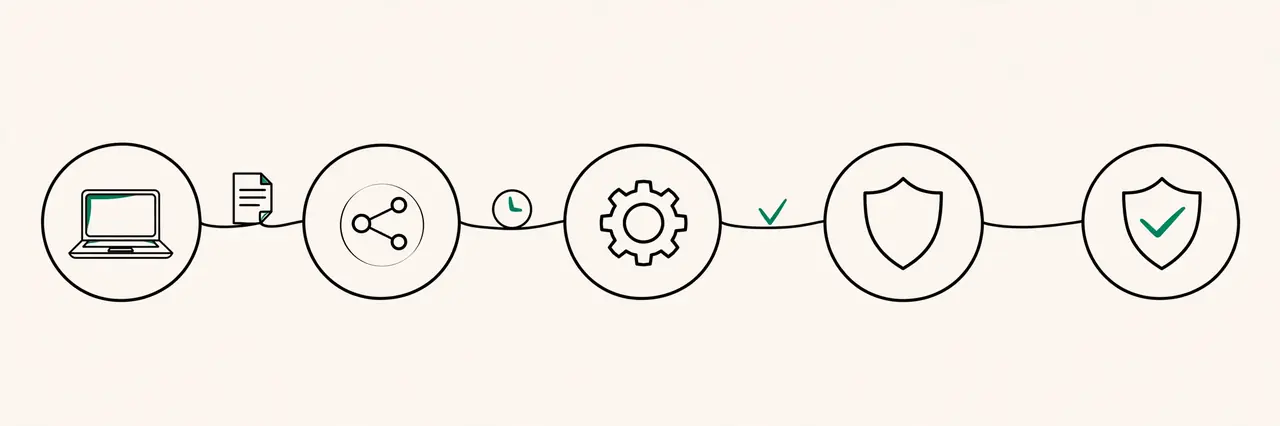
- Wait for the decision. Most healthy applicants hear back within minutes to 48 hours. If you get routed to manual review, it can take a week. Do not start a second application elsewhere while one is pending; duplicate applications can complicate underwriting.
One more thing: life insurance is one piece of the safety net. Before you lock in a policy, make sure your emergency fund is sized right. Insurance replaces income after you are gone; the emergency fund keeps the lights on while you are here.
The bottom line
The decision rule: if you are healthy, under 55, and need $250K to $1M in term coverage, the instant-decision tier is now the default sensible choice. You skip the nurse visit and the 3 to 6 week wait, and you pay about $33 a month instead of about $26 for traditional term on a $500K, 20-year policy. That is $84 a year for coverage that actually exists instead of a task you keep postponing.
The action takes under 20 minutes. Decide your coverage amount first, with ten times your income as the rule of thumb. Get quotes from three digital carriers on the same coverage amount. Answer the health questionnaire honestly, sign electronically, and name your beneficiaries. Most healthy applicants hear back in minutes to 48 hours.
The 2026 warning: never buy guaranteed issue out of laziness. It costs two to three times more for a tenth of the coverage, caps at $25K to $50K, and carries a two-year waiting period before the full death benefit pays out. It is a last resort for people who cannot qualify for anything else, not a convenience product.
Delay is the expensive choice here, not the exam. The premium gap grows with age, from about $7 a month at 35 to roughly $15 to $20 at 45 and wider still at 55, while 80 to 90% of healthy applicants pass the automated screen on the first try. If you are healthy and under 55, the screen is not the risk; another year of waiting is.
Let the age curve decide whether the exam is worth it. At 35 the instant-decision tier costs only about $7 a month more than traditional term, at 45 the gap is roughly $15 to $20 a month, and by 55 no-exam runs $130 to $160 against $95 to $110 traditional, so the younger and healthier you are, the more delay costs you. Get quotes from three digital carriers, use ten times income as the coverage rule of thumb, and only pay the guaranteed-issue price if health genuinely blocks every other tier.
FAQ
Is no-exam life insurance legit?
Yes. It is real term life insurance from licensed carriers, regulated the same way as traditional policies. The underwriting method is different, not the legal protections. Check that any carrier you consider is licensed in your state and rated A or better by AM Best.
Can I be declined for no-exam life insurance?
Yes. Instant-decision and simplified-issue policies still underwrite; they just use data instead of an exam. Serious health issues, recent hospitalizations, or risky records in the MIB database can lead to a decline or a reroute to full underwriting.
How much more does no-exam life insurance cost?
Expect 20 to 40 percent more than a fully underwritten term policy for the same person and coverage. For a healthy 35-year-old buying $500K of 20-year term, that is roughly $7 to $16 extra per month. Guaranteed-issue policies cost far more and should be a last resort.
Does no-exam life insurance cover COVID or pre-existing conditions?
Pre-existing conditions are handled the same as traditional policies: disclosed conditions may raise your rate or exclude you, depending on the carrier and the condition. A past COVID infection alone does not disqualify you with most carriers in 2026.
Can I switch from no-exam to traditional term later?
You can apply for a new traditionally underwritten policy anytime and cancel the old one, ideally after the new policy is approved and in force. Never cancel existing coverage before the replacement is active.
The Verdict
No-exam life insurance won because it removed the two things people hated most: the needle and the wait. For a healthy person under 55 who needs $250K to $1M in term coverage, the instant-decision tier is now the default sensible choice. You pay a modest premium for the convenience, and you get something priceless in return: coverage that actually exists instead of a task you keep postponing.
If your health is complicated or you need a very large policy, take the exam and take the lower price. For everyone else, the data already knows you are healthy. Let it do the talking.
Want more practical guides like this?
Browse all 80 guides across 10 categories, no fluff, no paywall.
Browse all guides →Explore Insurance guides