Roth IRA Conversion Ladder 2026: Pay Less Tax in Retirement
There is a legal way to pay 12% tax instead of 26% on your IRA money and never pay tax on it again. It is called a Roth conversion ladder. Here are the 2026 rules, the bracket math, and the mistakes that eat the savings.

There is a legal way to move money out of your traditional IRA, pay tax on it at 12% instead of 24%, and then never pay tax on it again. Not a loophole a salesman invented. A strategy the tax code explicitly allows, and one that financial planners quietly build into retirement plans for clients with six-figure IRA balances. It is called a Roth conversion ladder, and the idea fits in one sentence: instead of converting your whole IRA in one year and getting pushed into a high tax bracket, you convert a slice every year during your lowest-income years, and each slice unlocks tax-free five years later.
Run the numbers and the difference stops being abstract. Take $500,000 in a traditional IRA. Convert it all in one year and the federal tax bill lands near $130,000, an effective rate around 26%. Spread the same $500,000 across ten years at $50,000 a year and the total tax drops to roughly $60,000, an effective rate near 12%. Same account, same money, $70,000 difference. The only cost is patience.
Why write about it now, in October 2026? Because the rules just changed in your favor, and the clock that matters most (the five-year rule) rewards people who start early. Here is how the ladder works, what the 2026 brackets actually let you convert, and the four mistakes that eat the savings.
How a conversion ladder actually works
A Roth conversion is simple: you move money from a traditional IRA (where you got a tax deduction going in) to a Roth IRA (where growth and withdrawals are tax-free). You pay income tax on the amount you move, in the year you move it.
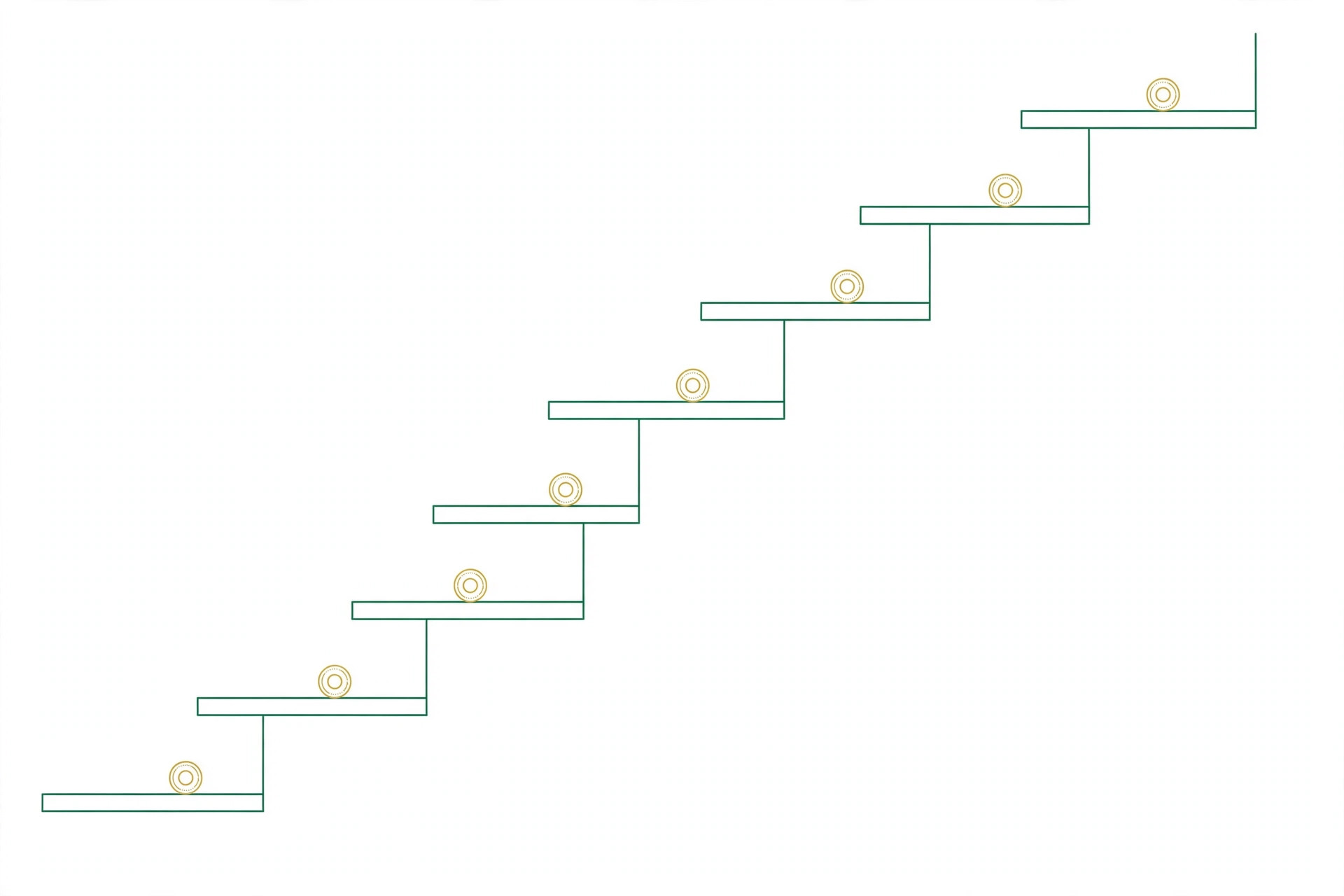
The ladder adds two refinements. First, you split the move into annual chunks sized to fit inside low tax brackets, year after year. Second, each chunk becomes available to withdraw penalty-free after five years. Stack enough years and the chunks start unlocking on a rolling schedule, like rungs of a ladder appearing one after another.
A concrete picture. You retire at 55 with $600,000 in a traditional IRA and about $40,000 a year of other income. Every December you convert $45,000 to your Roth. That $45,000 gets taxed at your lowest available rate. Five years later, the first $45,000 is available to withdraw whenever you want, no penalty, no tax. By age 60, new rungs unlock every year. You live off the unlocked rungs while the next ones finish seasoning.
Relevant ads will appear here once AdSense is connected.
This is the engine behind a lot of early retirement plans. The years between leaving work and starting Social Security (or required minimum distributions) are usually the lowest-income years of your life. Wages have stopped, Social Security has not started, and the tax code is offering you its cheapest rates. The ladder converts those cheap years into cheap lifetime tax.
The five-year rule (the part people get wrong)
Every conversion starts its own five-year clock. Convert money in 2026, and you can withdraw that principal starting in 2031 without the 10% early withdrawal penalty. The 2027 conversion unlocks in 2032, and so on. It is not one clock for the whole Roth. Each rung gets its own.
The part people get wrong: this rule governs the converted principal, not the earnings. Earnings have their own, stricter rule. You can withdraw earnings tax-free only if the Roth is at least five years old and you are 59 and a half (with a few exceptions). Mix this up and you can owe tax plus a penalty on the earnings portion of an early withdrawal.

Practical takeaway: if you want money available in 2031, the conversion has to happen in 2026. The IRS counts calendar years, so a conversion done in December 2026 starts the same clock as one done in January 2026. This is why planners say the best time to start a ladder is as early in your low-income window as possible.
Filling the bracket: where the real savings live
Here is the mechanic that makes or breaks the strategy. In 2026, a married couple filing jointly pays 10% on taxable income up to $24,800, 12% up to $100,800, and 22% up to $211,400. (Single filers: 10% to $12,150, 12% to $49,475, 22% to $105,700.) Your conversion amount is stacked on top of your other income, so every dollar of conversion eats into the bracket space above what you already earn.
"Filling the bracket" means converting exactly enough to reach the top of your target bracket, no further. Suppose you are married and your 2026 taxable income is $130,000. The 22% bracket runs to $211,400, so you can convert about $81,400 at 22% (minus a small buffer for safety). Convert $100,000 instead and the last $18,600 spills into the 24% bracket.

The 2026 standard deduction for joint filers is $32,200, which makes the math even better than it looks. Income covered by the standard deduction is taxed at 0%. A couple with $70,000 of IRA withdrawals can owe federal tax on less than $40,000 of it. This is why the early-retirement window is so valuable: the standard deduction plus low brackets can push your effective conversion rate into the single digits or low teens.
One more wrinkle for 2026. The same law that locked in the current rates added a new $6,000 deduction for each person 65 or older, running from 2025 through 2028. It phases down once joint income passes $150,000 ($75,000 single) and disappears at $250,000 ($175,000 single). Conversion income counts toward that total, so a big conversion can quietly shrink this deduction. Inside the 22% bracket, a couple where both spouses are 65 plus can face an effective rate closer to 24.6% on conversion dollars that land between $150,000 and $250,000 of income. Worth knowing before you size a December conversion.
What changed for 2026
Two things make 2026 different from the last few years.
First, the rates are now settled law. The One Big Beautiful Bill Act, signed in July 2025, made the current individual tax rates permanent. Earlier planning had to hedge against rates snapping back up in 2027. That cliff is gone. If your bracket in 2026 looks like your bracket in 2030, the conversion math gets cleaner, and the benefit comes from your own income trajectory (low now, higher later when RMDs start) rather than from guessing what Congress does next.
Second, the pro-rata rule still applies and still trips people up. If you have both pre-tax and after-tax (nondeductible) money in any traditional IRA, you cannot cherry-pick the after-tax part for your conversion. Every dollar you convert is treated as a proportional mix of pre-tax and after-tax money across all your IRAs combined. The fix: roll pre-tax IRA balances into your current 401(k) before converting, which clears the way for a clean backdoor Roth. File Form 8606 with your return to report the conversion and track any basis.
What has not changed: you cannot undo a conversion. The old recharacterization option disappeared years ago. Once the money moves, the tax bill for that year is locked in. This is why converters leave a buffer (convert to just under the bracket top, not exactly to it) and do the final conversion in December, when the year's other income is known.

A worked example: the $70,000 difference
Meet Priya, 56, who sold her business and now lives off savings. She has $500,000 in a traditional IRA and about $10,000 a year of interest income. She needs the money to start flowing at 61. Two paths:
Path A: convert it all in 2026. The $500,000 stacks on top of her $10,000 of income. Most of it lands in the 32% and 35% brackets. Federal tax: roughly $130,000. Effective rate: about 26%.
Path B: the ladder, $50,000 a year for 10 years. Each year, the conversion fills the lower brackets. Most years the bulk is taxed at 12% and 22%. Total federal tax across the decade: roughly $60,000. Effective rate: about 12%. The 2026 rung unlocks in 2031, the 2027 rung in 2032, and from 2032 on she has penalty-free access to a rolling stream of converted principal, which can then grow tax-free inside the Roth (ideally in something simple like beginner-friendly index funds).
The catch in Path B is honest: the unconverted balance stays in the traditional IRA, still growing and still subject to required minimum distributions starting at 73. If the account grows faster than she converts, RMDs can eventually push her income up anyway. The ladder is not "set and forget." Recheck the bracket math every December and adjust the rung size to your actual income.
Four mistakes that erase the savings
1. Tripping IRMAA. Medicare's Income-Related Monthly Adjustment Amount looks back two years. A 2026 conversion raises your 2028 premiums if it pushes modified adjusted gross income past the threshold (around $218,000 for a married couple in 2026). The surcharge is a cliff, not a slope: one dollar over costs the full higher premium. If you are 63 or older, check the IRMAA line before sizing a conversion.
2. Paying the tax from the IRA itself. If you withhold 20% for taxes from a $50,000 conversion, only $40,000 lands in the Roth, and the $10,000 withheld counts as an early distribution (tax plus a 10% penalty if you are under 59 and a half). Pay the tax bill from cash outside the IRA whenever you can, which is one more reason to keep a proper cash cushion (see our guide on how much emergency fund you actually need). If you cannot, shrink the conversion to what you can afford to fund.
3. Converting during a high-income year. The ladder works because the conversions happen in low-income years. Converting while you are still earning a full salary, or in a year with a big bonus or property sale, wastes the strategy. The whole point is arbitraging your own income timeline: pay tax at 12-22% now instead of 24-32% later when RMDs and Social Security stack up.
4. Ignoring state tax. Nine states have no income tax at all. If you are planning a move in retirement, converting after the move can save the state slice too. Conversely, converting in a high-tax state right before moving away hands that state money it did not have to get. A couple of percentage points on a $500,000 conversion is real money.
FAQ
How long does a Roth conversion take to become available?
Each conversion's principal is available penalty-free after five calendar years. A 2026 conversion unlocks in 2031, a 2027 conversion in 2032. Plan backward from when you need the money.
Is there a limit on how much I can convert each year?
No annual cap. The limit is practical, not legal: convert only what fits in your target tax bracket. There is no rule against converting $200,000 in a year, but the tax bill usually makes it a bad idea.
Can I do a Roth conversion after 59 and a half?
Yes. The 10% early withdrawal penalty disappears at 59 and a half, but the income tax on the converted amount still applies. Conversions in your 60s are common for managing required minimum distributions later.
Does a Roth conversion affect Medicare premiums?
Yes. IRMAA uses your modified adjusted gross income from two years earlier, so a 2026 conversion can raise 2028 Part B and Part D premiums if it pushes you over the threshold. Check the current thresholds before converting if you are 63 or older.
What is the difference between a Roth conversion ladder and a backdoor Roth?
A backdoor Roth is for high earners who cannot contribute to a Roth directly: they make a nondeductible traditional IRA contribution and convert it. A conversion ladder is for anyone moving existing pre-tax IRA money to Roth over several years to pay tax at lower rates. Different problems, same tool.