Founder Fall Health Check 2026: Screen Before the Rush
October is the last calm window before the holiday rush. Use this founder fall health check to book screenings, blood work, and a mood check now, while you still have a calendar to book them in.
The short answer: A founder fall health check is one primary care visit in October or November covering blood pressure, cholesterol and blood sugar labs, weight and waist, a sleep review, a short mood screening, and vaccine status. Book it now, because once the holiday rush starts, it slides to January, and January slides to never.
Key numbers at a glance
- 18.3% of US adults reported currently having or being treated for depression in Gallup's 2025 National Health and Well-Being Index, an estimated 47.8 million people
- 26.7% depression rate among adults under 30 in the same index, more than double the 13% recorded in 2017
- 45 the age colorectal screening starts in the US, added to the panel by age and family history
- 2 days the minimum strength training frequency that protects muscle and metabolic health for busy founders
- October National Depression and Mental Health Screening Month, and the start of flu shot season
- 30 percent is roughly how much sleep deprivation can cut productivity, per National Sleep Foundation figures cited in the guide, which is why sleep is treated as business infrastructure, not a wellness extra.
- 20 to 30 minutes is the brisk walk most days that covers the cardiovascular base, clears the head between deep work blocks, and doubles as the phone call slot for calls that do not need a screen.
- 14416 Tele-MANAS helpline is the free confidential mental health support the guide names for readers in India, beside the October screening message for founders everywhere.
- 10 year cardiovascular risk question is the first question the guide says to ask from blood work: what is my 10 year cardiovascular risk, and what moves it most, covering cholesterol, blood sugar, kidney and liver markers, with thyroid and vitamin D added if history suggests them.
Here is a pattern I see in founders every autumn. January starts with a health kick. By March the business eats it. By October the founder is running on caffeine, bad sleep, and a calendar that has no white space left. The health check they meant to book in spring is still unbooked, and now the holidays are coming, which means it will not happen this year either.
October is the fix for that pattern, and it is not a coincidence. October is National Depression and Mental Health Screening Month, flu shot season is open, and it is the last stretch of the year where a founder can still get an appointment without fighting holiday schedules. The October 2026 longevity conversation has shifted in a useful direction too: away from expensive biohacking theatre and toward measurable foundations, sleep, muscle, stress, and blood sugar, treated as business infrastructure rather than vanity. A founder with unstable sleep and unmanaged blood sugar has a personal operating problem that will eventually become a company problem.
This guide is the practical version of that shift. No supplement stack, no $10,000 retreat, no 20 item morning routine. Just the checkup, the labs, the sleep review, the mood screening, and the movement and food minimums that keep a founder functional through the hardest quarter of the year. If you book one appointment from this article, book the primary care visit. Everything else follows from it.
What is a fall health check, really?
A fall health check is a single primary care visit in October or November that establishes your baseline numbers before the holiday season distorts them.

The timing is the point. Holiday eating, travel, late nights, and end of year work stress all move your numbers in the wrong direction. A checkup in October gives you a clean baseline and a chance to fix anything flagged before the season piles on. A checkup in January gives you a post-holiday reading that is hard to interpret and easy to ignore.
What to bring to the visit matters as much as the visit itself. Bring a list of every medication and supplement you take, including the ones you bought online and forgot to mention last time. Bring your family history, updated with anything new from parents or siblings. Bring your last lab results if you changed clinics. And bring three honest answers: how you sleep, how your mood has been, and how much you actually move in a normal week. Doctors can only work with what you tell them, and founders are famously optimistic reporters on all three.
If you do not have a primary care doctor, October is also the right month to get one. Urgent care is for urgent problems. A health check needs someone who will see your numbers year over year and notice the trend, not just the single reading.
| Check | What it covers |
|---|---|
| Blood pressure | Checked at least yearly, tracked year over year |
| Cholesterol and blood sugar labs | Core labs, on the schedule your clinician sets |
| Weight and waist | Measured at the visit, part of the baseline |
| Sleep review | How you sleep, a metric most founders never measure |
| Mood screening | Short validated questionnaire, routine in modern primary care |
| Vaccine status | Flu shot and other vaccines due, flu season open in October |
Founder fall health check panel: blood work and screenings
The core of the visit is short and unglamorous, which is exactly why it works. Blood pressure, checked properly, seated, after five minutes of rest, not rushed in from the parking lot. Weight and waist circumference, because waist tracks metabolic risk better than weight alone. Blood work covering cholesterol, blood sugar (fasting glucose or HbA1c), and kidney and liver markers, with thyroid and vitamin D added if your history suggests them.

Why these, and why now? Because the three numbers that quietly end founder careers, blood pressure, cholesterol, and blood sugar, cause no symptoms at all in their early stages. You do not feel high cholesterol. You do not feel prediabetes. You feel fine, right up until you do not. Screening is the only way to catch them early, and early is when they are cheapest and easiest to reverse with habits rather than medication.
Ask your clinician two questions at the end of the visit. First, what is my 10 year cardiovascular risk, and what moves it most? Second, what should I recheck, and when? The second question is the one people forget, and it is the one that turns a single visit into a system. A number without a recheck date is trivia. A number with a recheck date is a plan.
Age and family history add items to the panel: colorectal screening from age 45 in the US, skin checks if you have sun exposure or family history, eye and dental visits that founders routinely skip. Your clinician will tailor this, but the founder's job is to show up and ask, not to guess which screenings apply.
What about sleep, the metric nobody measures?
Founders track revenue, churn, runway, and website traffic. Almost none track sleep with the same seriousness, even though sleep deprivation can cut productivity by around 30 percent, according to National Sleep Foundation figures cited across founder health research. That is a bigger hit than most business problems you spent the week solving.

The checkup conversation about sleep should cover four things: how long you sleep, how long it takes to fall asleep, whether you wake up often, and whether you snore loudly or wake up unrefreshed. Loud snoring with daytime sleepiness is worth mentioning specifically, because sleep apnea is common, underdiagnosed, and very treatable, and it masquerades as low motivation or brain fog for years.
The practical minimum that works for most founders is boring and effective: a fixed wake time, even on weekends, a wind-down hour with the phone charging outside the bedroom, a cool dark room, and no caffeine after midday. Our founder sleep protocol goes deeper on the full routine, but if you take one change from this section, make it the phone outside the bedroom. It is the single highest leverage sleep intervention most founders have never tried.
One more thing to tell your clinician honestly: shift work, late night launches, and travel across time zones. These are not character flaws, they are occupational exposures, and they change what sleep advice actually fits your life.
Fall health check mood screening: why founders should add it
Yes, and October is the month designed for it. National Depression and Mental Health Screening Month exists because mood problems are common, treatable, and routinely missed when nobody asks. Gallup's 2025 index put current depression at 18.3 percent of US adults, about 47.8 million people, and at 26.7 percent among adults under 30, more than double the 2017 figure. Founders are not exempt from those numbers. If anything, the isolation, financial pressure, and identity entanglement of running a company push the risk higher.

A mood screening is not therapy and it is not a label. It is a short validated questionnaire, usually under ten questions, about mood, sleep, energy, and interest over the past two weeks. It takes three minutes, and it gives your clinician a score to track over time, the same way blood pressure gives a number to track. A high score starts a conversation, not a verdict.
How to tell tiredness from burnout is the question founders ask most, and the distinction is useful. Tiredness improves with rest. Burnout persists, with exhaustion plus growing cynicism about the work plus a sense of declining effectiveness. If rest does not restore you, if you dread work you used to enjoy, or if small decisions feel enormous, say so at the visit. These are clinical signals, not weaknesses, and they are far more common than founder culture admits.
If you are in India, the government's Tele-MANAS helpline (14416) offers free confidential mental health support. Wherever you are, a peer group, a mentor, or a coach who has run a company is a better first conversation than isolation. The screening is the doorway. What matters is walking through it.
What movement actually fits a founder schedule?
The fitness advice founders get is usually written for people with free mornings and no board meetings. The version that survives a real founder calendar is smaller and more stubborn: a daily walk and two short strength sessions a week.

Autumn is the best season to start the walking habit, and that is not a coincidence either. Cooler air, golden light, and a natural break in the summer routine make a morning or lunchtime walk easier to keep than a gym habit that depends on a commute. A brisk 20 to 30 minute walk most days covers the cardiovascular base, clears the head between deep work blocks, and doubles as the phone call slot for calls that do not need a screen.
Strength training twice a week is the part founders skip and the part they can least afford to skip. Muscle is metabolic infrastructure: it protects blood sugar, posture, and independence as you age, and two 30 minute sessions, even at home with dumbbells or bodyweight, are enough to hold the line. Our minimum effective wellness playbook sets out the two day template in full, but the principle is simple: never miss twice, and a short session beats a skipped perfect one.
The rule that keeps both habits alive through the holiday quarter is to anchor them to something that already happens. Walk after lunch, not at some aspirational 5am. Strength sessions on the same two weekdays, booked like meetings. When travel breaks the routine, the walk survives anywhere, which is why it is the base habit and everything else is a bonus.
What should you eat when delivery is the default?
Founder nutrition fails in one specific place: the working lunch. When delivery is the default, the meal is chosen by hunger, speed, and whatever app opens first, which usually means refined carbs, too much salt, and a crash at 3pm that gets solved with more caffeine.

The fix is not a diet. It is a default. Pick three lunches you actually like that combine protein, vegetables, and a whole grain, and rotate them. A grain bowl, a salad with chicken or tofu, a soup with bread, whatever fits your taste and your delivery options. The point of a default is that it removes the decision, and the decision is where the bad meal happens.
Two more founder-specific moves. First, eat away from the screen at least once a day. A meal eaten while answering email is barely registered by the brain, and hunger returns an hour later. Second, keep water visible on the desk. Dehydration mimics fatigue, and founders misread it constantly. Neither move requires willpower, a meal plan, or a new app, which is why they survive.
Alcohol deserves one honest line here, because autumn social season ramps it up. If sleep is already fragile, alcohol makes it worse even in small amounts, by fragmenting the second half of the night. Cutting back in the last quarter of the year is one of the highest return sleep interventions available, and it costs nothing.
What about flu shots and vaccines?
October is flu shot season, and for a founder the case is practical rather than moral. Influenza costs a week of work at the worst moment of the year, right when holiday sales, year-end closes, and family travel collide. A flu shot takes ten minutes at a pharmacy and reduces both the chance of illness and its severity if you do catch it.
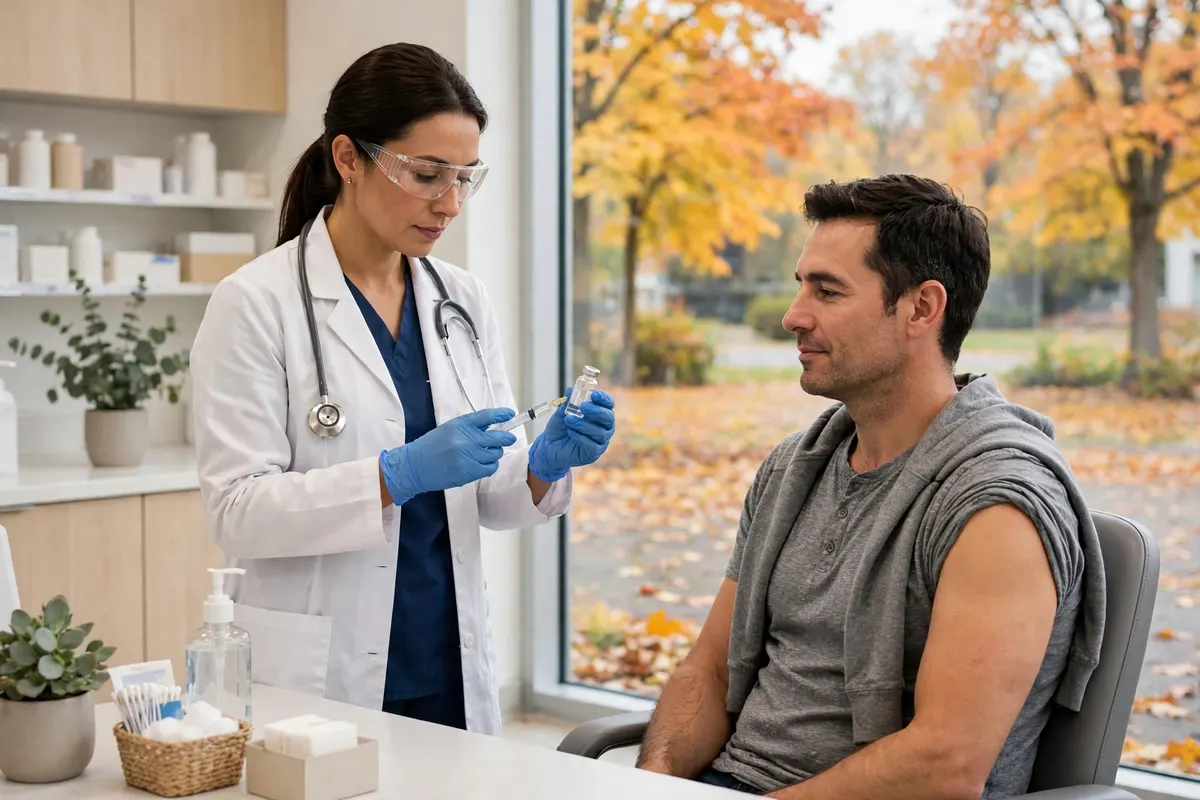
Ask about the rest of your vaccine status at the same visit: tetanus booster timing, COVID booster eligibility, and any travel vaccines if you have trips planned. Founders who travel for conferences or supplier visits often need vaccines they never think about until the trip is booked.
The same visit is also the right moment to sort the boring admin that protects a founder's health: an updated emergency contact, a list of medications stored where a partner or co-founder can find it, and a plan for who makes decisions if you are ever incapacitated. Nobody enjoys this paperwork. Everybody is grateful it exists when it is needed.
The bottom line
A founder fall health check is one visit, a handful of labs, a sleep conversation, a three minute mood screening, and a flu shot. That is the whole intervention, and it is enough to catch the silent numbers, blood pressure, cholesterol, blood sugar, before they become emergencies, and to put a system around the habits that actually sustain a founder: sleep, walking, two strength sessions, and a default lunch.
Book it this week, while October still has appointments. Bring your medication list, your family history, and honest answers about sleep and mood. Ask what to recheck and when, so the visit becomes a system rather than a single event. And treat the result the way you would treat a business metric: track it, review it, and act on the trend, not just the single reading.
Your company needs you functional in December, not just in January. The checkup is how you make sure of that, and October is when it is cheapest to do.
Book the foundations before the fancy tests. A 20 to 30 minute walk most days plus two 30 minute strength sessions a week holds the line that a $10,000 retreat cannot buy, and the October screening panel only helps if you actually book it before the rush. Start with sleep, muscle, and the blood work panel, then add one habit at a time, because a founder health check that produces a 20 item routine produces nothing.
Treat October as a screening month, not a biohacking month. Book the blood panel, the dental and eye visits founders routinely skip, and the age based screenings like colorectal screening from age 45, then walk after lunch instead of chasing an aspirational 5 am routine, because a walk that actually happens beats a routine that does not. Sleep is business infrastructure when deprivation can cut productivity by around 30 percent, and a mental health check in National Depression and Mental Health Screening Month is a foundation, not an extra.
Frequently asked questions
What should a founder health check include?
Blood pressure, cholesterol and blood sugar labs, weight and waist measurement, a sleep review, a mood screening, and vaccine status, plus any age or family-history specific screenings your clinician recommends.
Why is October a good month for a health check?
October is National Depression and Mental Health Screening Month, flu shot season is open, and it is the last calm window before the holiday rush takes over founder calendars.
How often should founders get checked?
Most healthy adults benefit from an annual checkup, with blood pressure checked at least yearly and labs on the schedule your clinician sets based on age, history, and results.
Is a mood screening really part of a physical?
Yes. A short validated questionnaire about mood, sleep, and energy is a routine part of modern primary care, and it is the fastest way to start a conversation about burnout or depression.
What if I have no symptoms at all?
That is exactly when screening helps most, because high blood pressure, high cholesterol, and early blood sugar problems usually cause no symptoms at all.
For the wider health picture, read our burnout-proof founder guide for the business case against burnout, our founder sleep protocol for the full sleep routine, and our minimum effective wellness playbook for the two day strength template. For outside data, see the October screening month announcement, October 2026 longevity trends, and the founder burnout business risk essay.
Want more practical guides like this?
Browse all 86 guides across 10 categories, no fluff, no paywall.
Browse all guides →Explore Healthcare guides