Rental Arbitrage 2026: Earn Without Owning Property
Rental arbitrage lets you earn short-term rental income without buying a property. Here is the startup cost, the profit math, and the legal check that decide whether one unit makes money.
The short answer: Rental arbitrage means leasing a home long term, with the landlord's written permission to sublet, furnishing it, and renting it by the night. You keep the gap between guest income and rent plus costs. In 2026 a well run unit typically nets $500 to $2,000 a month, if the city and lease allow it.
Key numbers at a glance
- $5,000 to $15,000 typical startup cost per unit: deposit, first month rent, furnishings, smart lock, photos, permits, and insurance
- $500 to $2,000 typical monthly net profit for a well run unit in 2026, with top operators clearing $2,000 to $5,000
- 138% more gross revenue for the average short term rental than the same unit's annual long term rent in 2025, down from a 214% peak in 2021
- 12% Vrbo host commission from October 29, 2026, which changes the math on every Vrbo booking
- $150 Atlanta's annual short term rental license fee, a useful example of how cheap a permit can be and how strict the rules still are
- 102 dollars profit with a 3 night minimum is the guide's turning point: the same unit lost 752 dollars at 70 percent occupancy with a cleaner on every turnover, and still lost 202 dollars at 24 nights, but with a 3 night minimum, 21 booked nights, and only 7 turnovers, costs fell to 3,048 dollars against 3,150 dollars of revenue.
- 165 dollars a night or rent near 1,550 dollars is what the guide says the losing unit needs to work: at 1,800 dollars of rent and 145 dollars a night the math fails, and either a nightly rate closer to 165 dollars or rent closer to 1,550 dollars is required.
Here is the pitch you have probably seen: rent an apartment, list it on Airbnb, and pocket the difference without ever buying a house. The pitch is not a lie, but it leaves out the three parts that decide whether you make money or lose your deposit. You need a landlord who says yes in writing, a city that allows the use, and a monthly cost low enough that a slow month does not wipe you out.
I am going to walk through rental arbitrage the way an operator would, not the way a course seller would. That means real startup costs, a worked profit example with honest occupancy, the lease clauses that matter, the cities where this is simply banned, and the exact moment to walk away from a unit. If you finish this guide and decide rental arbitrage is not for you, that is a good outcome too. A unit you do not sign is a loss you never take.
What is rental arbitrage, really?
Rental arbitrage is leasing a home long term, furnishing it, and renting it by the night with the landlord's written permission to sublet.

Rental arbitrage, also called Airbnb rental arbitrage or rent to rent, is simple on paper. You sign a long term lease, usually 12 months, on a property you do not own. Your lease includes a written addendum that lets you sublet the home for short stays. You furnish it, photograph it, list it on Airbnb, Vrbo, and Booking.com, and you keep what guests pay minus rent, utilities, cleaning, platform fees, supplies, and software.
Notice what you do not get. You build no equity. You do not benefit if the property value rises. At the end of the lease, the landlord can decline to renew, raise the rent, or take the unit back, and your business in that unit ends. That is the trade: low capital to start, zero ownership at the end. If your goal is wealth through property, buying beats rental arbitrage every time. If your goal is cash flow without a $50,000 down payment, rental arbitrage is one of the few doors that is actually open.
The other thing to get straight is that this is a hospitality business, not passive income. Guests message at midnight. Cleaners cancel. A neighbor complains about noise. The operators who last are the ones who treat guest communication, cleaning, and pricing as daily work, not as a set and forget listing. If you want truly passive income, buy an index fund. Rental arbitrage pays you for running a small hotel, one unit at a time.
| Worked scenario | Gross revenue | Total costs | Net |
|---|---|---|---|
| 70% occupancy, 21 nights at $145 | $3,045 | $3,797 | -$752 |
| 24 nights, weekend-weighted pricing | $3,480 | $3,682 | -$202 |
| 3 night minimum, 21 nights, 7 turnovers | $3,150 | $3,048 | +$102 |
What does the profit math actually look like?

Here is the equation that matters: nightly rate times booked nights must beat rent plus utilities plus cleaning plus platform fees plus supplies plus software, with room left over. Let us run a realistic mid tier example, not a best case one.
Say you lease a two bedroom unit for $1,800 a month. Utilities run $180. Cleaning costs $90 per turnover, and you average 12 turnovers a month, which is $1,080. Supplies, restocking, and laundry add $200. Software for pricing, messaging, and locks runs $80. Platform fees average 15% of guest revenue. Your nightly rate averages $145, and you book 21 nights in the month, a 70% occupancy rate.
Gross guest revenue is $145 times 21, which is $3,045. Platform fees at 15% take $457. Your fixed and operating costs are $1,800 plus $180 plus $1,080 plus $200 plus $80, which is $3,340. Add the $457 in fees and your total cost is $3,797. That month loses $752. This is the part most pitch decks skip: at 70% occupancy with a cleaner on every turnover, a $1,800 rent can still lose money.
Now change two things. Raise occupancy to 24 nights by pricing weekends higher and midweek lower, and cut cleaning cost by using a $75 turnover rate with a reliable cleaner on a regular schedule. Gross revenue becomes $3,480. Fees are $522. Cleaning falls to $900. Total costs are $3,682. The month nets a loss of $202, still not a win. The honest lesson is that this unit, at this rent, needs either a nightly rate closer to $165 or a rent closer to $1,550 to work. That is exactly the calculation to run before you sign anything. If the numbers only work at 90% occupancy and peak season rates, the unit is a no.
A healthier version looks like this. Rent $1,550, nightly rate $150, 22 booked nights, cleaning $85 across 12 turnovers. Gross revenue is $3,300. Fees at 15% are $495. Costs are $1,550 plus $170 utilities plus $1,020 cleaning plus $180 supplies plus $80 software, which is $3,000, plus $495 in fees, for $3,495 total. That still loses $195, which tells you something important: cleaning cost is the silent killer in this model. The fix is longer stays. One 5 night booking needs one turnover, while five 1 night bookings need five. This is why experienced operators push minimum stays of 2 or 3 nights and price weekly stays to attract them. Fewer turnovers, same rent, far better margin.
Run the same unit with a 3 night minimum, 21 booked nights, and only 7 turnovers. Gross revenue is $3,150. Fees are $473. Cleaning is $595. Total costs are $1,550 plus $170 plus $595 plus $180 plus $80 plus $473, which is $3,048. Net profit is $102. Still thin. Now you see why the operators who report $500 to $2,000 a month per unit either pay lower rent relative to nightly rates, run in stronger markets, or both. Your market pick is the whole game, which brings us to the part you must get right before you sign.
How to get landlord permission for rental arbitrage

No landlord permission, no business. A verbal yes is worth nothing when a neighbor complains or a lease renewal comes up. You need a written addendum to the lease that names short term rental use, names the platforms you will use, and states who holds insurance and who handles guest issues. If a landlord will not put it in writing, walk away, however good the rent looks.
Landlords who allow rental arbitrage usually want something in return. The common trade is a premium over market rent, a longer lease term, or both. A landlord might charge $100 to $200 above market rent in exchange for the addendum, and that premium must go into your profit math from day one. Other landlords ask for proof of commercial short term rental insurance naming them as additionally insured, a larger security deposit sized for guest turnover, and a promise that you, not they, handle every guest complaint.
How you pitch it matters. Landlords hear "Airbnb" and picture parties. Pitch the reality instead: professional cleaning after every stay, a smart lock so no keys change hands, a noise monitor, a written house rule set, and your phone number as the first call for any issue. Offer a trial clause: a 90 day review where either side can end the short term use if complaints exceed an agreed number. Many landlords who refuse a cold pitch will accept a structured one, because you have answered their real fear, which is not the rent, it is the risk to their property and their neighbors.
One more clause to fight for: renewal terms. If you build a listing with 100 reviews and the landlord doubles the rent at renewal, you lose the business you built. Ask for a renewal cap or a right of first refusal in the addendum. You may not get it, but asking costs nothing, and a landlord who agrees in principle is telling you they see this as a partnership, not a loophole.
What do city rules and HOAs allow?

Rental arbitrage is legal in most US jurisdictions when your lease permits subletting and local rules allow non owner occupied rentals. That sentence hides a maze. Some cities ban non owner occupied short term rentals outright. New York City, under Local Law 18, effectively bans this model for most units. San Francisco and Los Angeles restrict it heavily. Other cities allow it with a license, a cap on nights, or a minimum stay rule.
Atlanta is a useful example of how a "yes, but" city works. The city licenses short term rentals to an owner or a long term tenant, and the license costs $150 a year. Until recently the code covered a primary residence plus one additional unit, and in September 2026 the council voted to remove that limit from January 1, 2027. Even in a permissive city, you still pay lodging taxes, in Atlanta's case 16.9% combined, and you still need the license before you host. The lesson is not about Atlanta. It is that every city has its own version of this page, and you must read it before you sign a lease.
Check four layers, in this order. First, the city or county short term rental ordinance: is non owner occupied hosting allowed, is a permit required, is there a night cap? Second, the building or HOA rules: many condos ban short stays even where the city allows them, and an HOA fine lands on the landlord, who will pass it to you. Third, the lease itself, which must permit subletting for short stays by name. Fourth, tax registration: most jurisdictions require you to register and remit lodging taxes, even when the platform collects some of them for you.
The safest test before you sign is the one experienced operators use: your break even occupancy should sit well below your market's average occupancy. If you need 80% occupancy to cover costs in a market averaging 65%, you are betting against the market. Find a different unit or a different market. And if any of the four layers above says no, the answer is no, no matter how good the nightly rate looks on a listing site.
How do you run the unit day to day?
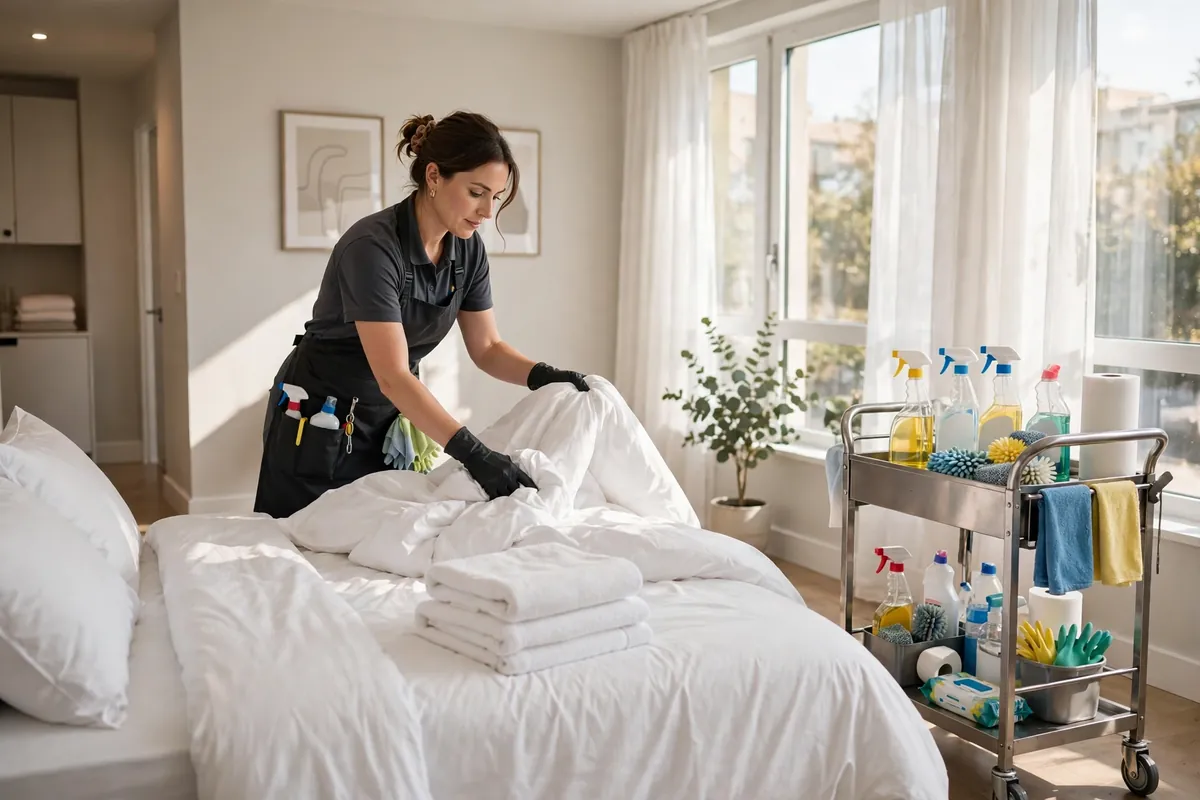
Startup costs cluster between $5,000 and $15,000 per unit. The breakdown for a one bedroom usually looks like this: deposit and first month rent $2,500 to $4,000, furnishings $2,000 to $5,000, a smart lock and basic safety gear $200 to $400, professional photos $150 to $300, permits and insurance $300 to $800, and a reserve of two months rent that you do not touch. Lean launches can land near $6,000, premium launches pass $20,000. The reserve is not optional. Your first month will have gaps, and rent is due whether or not a guest books.
Furnish for durability and photos, not for your own taste. A neutral sofa that survives 200 guests beats a beautiful one that stains in month two. Buy two sets of everything guests touch: bedding, towels, and kitchen basics, so a turnover never waits on laundry. Put a smart lock on the door, a lockbox as backup, and a simple welcome book with Wi-Fi, checkout steps, and your number. Guests forgive a small apartment. They do not forgive a dirty one, a broken lock, or silence when something goes wrong.
Cleaning is where this business is won or lost, and a reliable cleaner matters more than any software. Interview three cleaners before you sign a lease, not after. Pay a fair turnover rate, keep a backup cleaner on call, and use a checklist with photos after every clean. When a cleaner cancels on a same day turnover, your backup is the difference between a five star review and a guest arriving to an unmade bed. That one review can cost you more than a month of cleaner fees.
On operations, automate the repeatable parts and stay human on the rest. Automated messages for booking confirmation, check in, and checkout save hours. Pricing software adjusts nightly rates to demand. But when a guest reports a leak or a lock problem, a human reply within minutes beats any template. Guests remember how problems were handled far longer than they remember the thread count.
How do you price for real occupancy?

Pricing is not setting one nightly rate and forgetting it. Weekends, holidays, local events, and seasons move demand week to week, and a flat rate leaves money on the table in peak weeks and leaves you empty in slow ones. Use a pricing tool or, at minimum, a weekly habit: check comparable listings in your neighborhood every Monday, adjust the next 30 days, and keep your minimum stay at 2 or 3 nights to protect your cleaning margin.
Platform fees deserve a line of their own in your math. Airbnb's host fee is typically 3% on the standard split, while Vrbo moved to a 12% host commission from October 29, 2026. That change alone can turn a Vrbo heavy unit from profitable to marginal, which is why direct bookings matter so much. A direct booking channel, through your own site and repeat guests, avoids platform commission entirely, and it is the single best margin lever once you have reviews. Our guide to direct bookings walks through how hosts build that channel without violating platform rules.
Occupancy targets should be honest. A market average of 65% to 70% is a good planning number in many US cities, not 90%. Price for the occupancy you will actually get, then test: if you are booked solid three weeks out, your price is too low. If you are empty next weekend, it is too high. Small weekly adjustments beat big monthly guesses, and they keep you from the worst mistake in this model, which is holding a high rate through an empty month out of pride.
Seasonality is the other trap. A beach market that prints money in July can sit empty in January, and your rent does not take January off. Before you sign, look at 12 months of comparable occupancy, not just the peak month a course screenshot shows you. If the annual average still covers costs with a cushion, the unit is worth pursuing. If only the peak months work, you are signing up for a winter of losses.
When should you walk away, or scale?

The risks are not theoretical. A city can change its rules mid lease. A landlord can refuse renewal. A bad guest can cause damage that exceeds your deposit. A slow season can stack three losing months in a row. Insurance helps, but read what it actually covers: standard landlord policies often exclude short term rental use, which is why operators buy commercial short term rental insurance and name the landlord as additionally insured. Get that quote before you sign, not after a claim.
Walk away when any of these are true. The lease does not allow subletting in writing. The city or HOA bans the use. Your break even occupancy is above the market average. The landlord will not agree to a renewal conversation. Or the startup cost would leave you with no reserve. Any one of these is enough. Operators who ignore the first two do not have a business, they have a countdown to an eviction notice or a fine.
If your first unit works for six months, scaling means repeating a proven system, not doubling down on hope. Add a second unit only in a market you already understand, with the same cleaner network and the same pricing habit. Most operators find that three to five units is where the work changes: you need a part time cleaner coordinator, a shared supply system, and a real bookkeeping habit, because at that point you are running a business with payroll, taxes, and guest liability, not a side project.
One honest comparison before you decide. Buying a rental property in 2026 often needs $50,000 or more for a down payment, and it ties you to one asset. Rental arbitrage needs $5,000 to $15,000 per unit and lets you test a market in a year. The price of that flexibility is that you own nothing at the end. If cash flow now matters more to you than equity later, rental arbitrage is a legitimate path. If equity matters more, save the startup money toward a down payment instead.
The bottom line
Rental arbitrage works in 2026 for operators who pick the right market, get landlord permission in writing, and run the numbers at realistic occupancy. Typical startup cost is $5,000 to $15,000 per unit, typical net profit for a well run unit is $500 to $2,000 a month, and the gap between those numbers is filled by cleaning costs, platform fees, and slow months, not by luck.
Before you sign, run the break even test: nightly rate times booked nights, minus rent, utilities, cleaning, fees, supplies, and software, at an occupancy below the market average. If that test fails, the unit fails, however nice the photos look. And check the city, the HOA, the lease, and the tax rules in that order, because any one of them can end the business before it starts.
Start with one unit, keep two months of rent in reserve, hire the cleaner before you sign the lease, and build a direct booking channel from your first repeat guest. If the first unit is still profitable after six months, you have a system worth repeating. If it is not, you have learned the market for the price of one lease, not five.
Underwrite at the market average, not at the course screenshot. A market average of 65 to 70 percent is a good planning number in many US cities, not 90 percent, and a unit that only works at 90 percent occupancy and peak season rates is a no. Look at 12 months of comparable occupancy, not just the peak month, price the landlord premium of 100 to 200 dollars above market rent into the math from day one, and ask for a 90 day trial clause so either side can end the short term use if complaints exceed an agreed number.
Frequently asked questions
Is rental arbitrage legal?
It is legal in most US jurisdictions when your lease permits subletting and local short term rental rules allow non owner occupied rentals. It is effectively prohibited in places like New York City under Local Law 18 and restricted in San Francisco and Los Angeles. Always get written landlord consent and confirm local permits before you sign.
How much money do I need to start rental arbitrage?
Most operators spend $5,000 to $15,000 per unit on deposit, first month rent, furnishings, a smart lock, photography, permits, and insurance. Lean launches can land near $6,000 and premium launches pass $20,000. Keep an additional two months of rent in reserve, because rent is due whether or not guests book.
How much profit can one rental arbitrage unit make?
Industry reporting based on AirDNA data puts the average short term rental at about 138% more gross revenue than the same unit's annual long term rent in 2025, down from a 2021 peak of about 214%. In practice, a well run unit typically nets $500 to $2,000 a month, with top operators clearing $2,000 to $5,000. Margins are tighter than they were in 2021, so market choice and cleaning costs matter more than ever.
Do I need landlord permission for Airbnb rental arbitrage?
Yes, in writing. A lease addendum should name short term rental use, the platforms you will use, insurance requirements, and who handles guest issues. Landlords often ask for a rent premium, a longer lease, proof of commercial short term rental insurance, and a larger deposit. A verbal yes is not enough.
Is rental arbitrage still profitable in 2026?
Yes, but only for operators who pick the right market and run tight operations. Higher rents and stricter rules mean the easy money from 2021 is gone. The model rewards people who treat it like a hospitality business: real cleaning standards, honest pricing, direct bookings, and a break even occupancy well below the market average.
For the wider picture, read our short term rental guide for how owning compares with arbitraging, our direct bookings playbook for cutting platform fees after Vrbo's 12% change, and our mid term rental strategy for the 30 day stays that cut cleaning costs. For outside data, see Hostfully's 2026 rental arbitrage guide, Awning's costs, risks, and rules breakdown, and Lodgify's complete 2026 guide.
Want more practical guides like this?
Browse all 84 guides across 10 categories, no fluff, no paywall.
Browse all guides →Explore Real Estate guides