AI Search Changed Marketing in November 2026: What Small Businesses Do Now
Google AI Mode now answers first, and the click to your website is no longer guaranteed. Here is how AI search marketing changed in November 2026, why the old traffic playbook is fading, and the five moves small businesses use to stay visible, cited, and booked.
The short answer: in November 2026, small business marketing is about being the business the AI answer names. That means clear answer pages on your own site, a clean product feed, searchable social posts, and reviews that prove you are real. Traffic comes, but it goes to businesses that are easy to cite, easy to trust, and easy to book.
Key numbers at a glance
- 57 percent of product links in Google AI Mode went to Google Shopping in a study covered in early November 2026, with fashion and beauty most likely to link only to Google pages
- About 0.9 percent was the click-through rate from AI features in a small publisher test shared in November 2026, after the site blocked AI Overviews and AI Mode and compared the results
- 3 times longer is how long AI Mode queries run compared with regular searches, according to Google on its third quarter 2026 earnings call, with search query growth at a five-year high
- 10 more countries are getting AI Mode ads, with multiturn ads that appear during follow-up questions already live in the United States
- 63 percent of users are less likely to engage with AI-generated visuals, per research cited in November 2026 social trend reporting
- 76 percent of consumers feel more loyal to brands that reply to comments or messages, while 52 percent are less likely to buy from brands that do not reply
- Nearly half of consumers form a negative opinion when brands use AI for customer replies, in the same November 2026 reporting
- 1.013 trillion dollars is the forecast for November and December 2026 US holiday sales, which is why rising holiday media costs matter right now
- Last 90 days of reviews to reply to with a specific detail in week two of the guide's 30-day plan
- Within 48 hours is when the first useful message should go out after a signup, not a discount blast, in the guide's list-building move
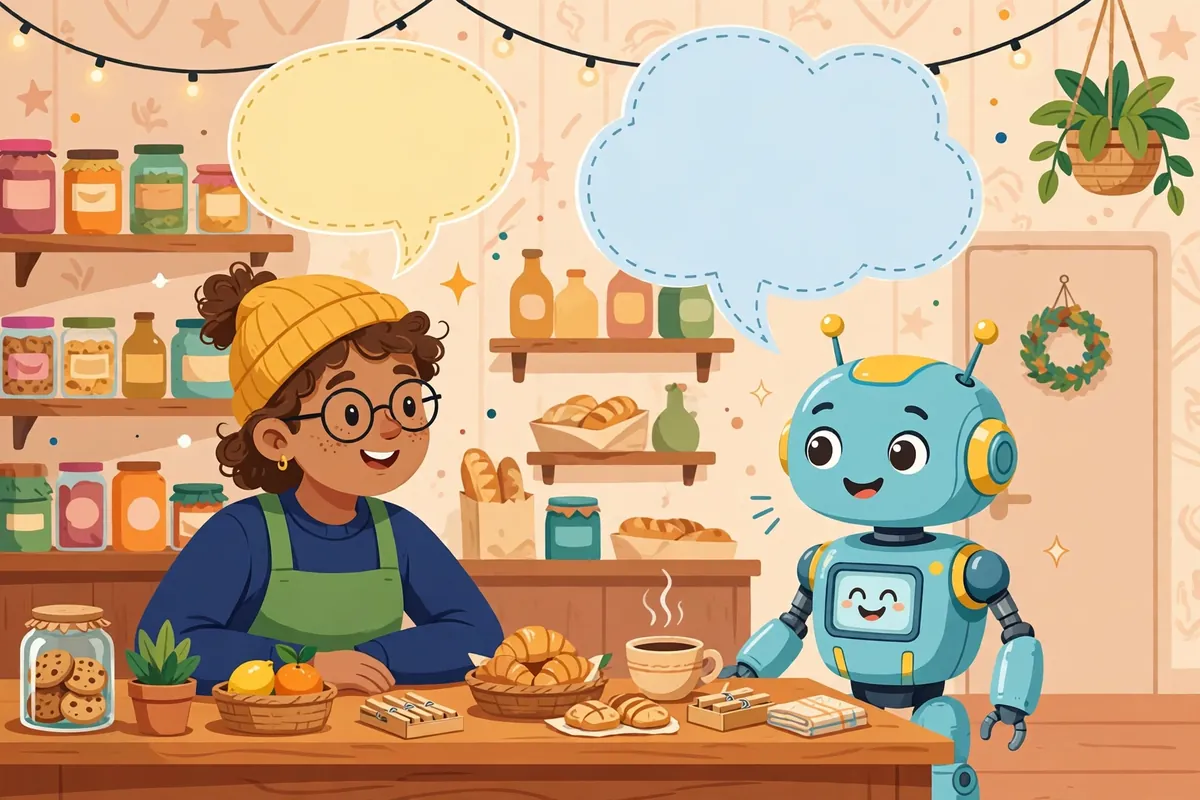
Ana runs a bakery in Portland, Oregon, with twelve seats, a loyal Saturday crowd, and a website that used to bring her three or four catering inquiries a week. This autumn the inquiries slowed, even though her Google ranking for her main terms had not visibly collapsed. She checked her analytics and found the pattern every small business owner is finding this month: people still search, but fewer of them click through, because the answer now arrives before the link. A shopper asks for the best bakery for a wedding cake near them, the AI answer names two or three shops with a summary, and most shoppers pick from the answer, not from page two of the results. Ana was not losing to a rival bakery. She was losing to the answer itself, because her site gave the AI nothing clean to cite.
She fixed it without a rebrand and without a bigger ad budget. She rewrote her catering page to answer the exact question first, in one paragraph, with prices, lead times, and flavors. She added a short FAQ, she replied to every review with a specific detail, and she posted one real behind-the-scenes video a week, the ovens, the hands, the morning light, not a polished stock clip. Within a month, her shop started appearing in AI answers for local cake questions, and the catering inquiries came back, not to the old volume, but to a volume she could plan around. That is the honest version of this story: AI search did not kill her marketing. It changed what marketing has to prove.
This guide explains the November 2026 shift in plain terms, then gives you the five moves that work now, a measurement plan that fits a small team, and a 30-day plan you can start this week. If you want the deeper background on getting cited, read our guide to getting cited by AI search first, then come back here for the November update. If your email list needs work before the holidays, our email marketing guide pairs with this one, because a list you own is the one channel AI cannot intermediate.

What changed in November 2026?
Three November 2026 developments, taken together, explain why small business traffic feels different this month: Google admitted AI Mode earns less per search, a study showed AI Mode sends most product links to Google Shopping, and a small test put AI click-through near 0.9 percent.
AI search marketing is the work of making your business the one an AI answer names and cites, instead of chasing clicks to a blue link.
Start with Google's own earnings call. On its third quarter 2026 call, Google said search query growth hit a five-year high, driven by AI, while search ad revenue growth still slowed. Chief business officer Philipp Schindler said AI Mode earns less per search than regular results, without saying how much less, and that AI Mode queries run about three times longer than regular searches, that most of them are extra searches rather than replacements, and that click-through rates are already similar for sponsored and organic product listings in AI Mode. Google also plans to bring AI agents to Search that can book reservations, schedule appointments, fill out forms, and make purchases, and it is expanding AI Mode ads to ten more countries, with multiturn ads during follow-up questions live in the United States.
Read that as a shop owner, not as an investor. More searches, longer conversations, and ads inside the answer itself mean the search page is becoming a place where the transaction happens, not a directory that sends you elsewhere. If your business can be booked, bought, or quoted inside that conversation, you have a chance. If your business only exists as a link ten results down, you are easy to skip. The November trend roundups put it bluntly: the question now is who gets paid when AI answers the search, and for now, Google mostly does.
The second development sharpens the point for shops that sell products. A study covered in early November found that Google AI Mode sends 57 percent of its product links to Google Shopping, with fashion and beauty products most likely to link only to Google's own pages. Treat that as a signal, not a final number, because it is one study, but the direction is clear: if you sell products and you have no product feed in Google Merchant Center, the AI answer has little reason to send a shopper to you, because it already has a clean, priced, shoppable option from Google Shopping. A product feed is no longer a nice extra for online shops. It is the entry ticket to the AI answer.
Why did clicks to small sites fall?
Because the answer got good enough, and short enough, that many searches end without a click. A small test shared in November 2026 made the number concrete: publisher Cyrus Shepard used Search Console controls to block one site from Google AI Overviews and AI Mode, then compared impressions, clicks, and click-through with the site in and out, and the result was a click-through rate of about 0.9 percent from the AI features. One site, one test, so do not treat 0.9 percent as a universal rate. Treat it as a warning about the order of magnitude: AI feature traffic is thin, and a business that depends on it alone will starve.
The deeper reason is that AI answers collapse the old funnel. A shopper used to search, scan ten links, open three, and compare. Now the shopper asks a full question, like "which bakery near me does gluten-free wedding cakes under 400 dollars with two weeks notice," and the answer tries to finish the job in one screen. If your site answers that exact question, with a price, a lead time, and a location, you can be named. If your site talks generally about "delicious cakes for every occasion," the answer has nothing specific to quote, so it quotes a rival who was specific, or it quotes nobody and sends the shopper to Google Shopping instead.
That is why the old advice to "write more content" is failing small businesses right now. More generic pages do not help an AI answer, because the answer needs one clean fact, not ten vague pages. One page that answers one question completely, with numbers, dates, prices, and a next step, beats five pages that gesture at the topic. This is also why our earlier AI search guide still holds up: it argued for direct answers, FAQ schema, and question headings, and November 2026 rewarded exactly those pages, while pages built for keyword volume quietly faded.

Why does real, human content win now?
Because shoppers are tired of polished emptiness, and November 2026 trend reporting says so in numbers. Research cited in that reporting found 63 percent of users are less likely to engage with AI-generated visuals, while 76 percent feel more loyal to brands that reply to comments or messages, and 52 percent are less likely to buy from brands that do not reply. Nearly half form a negative opinion when brands use AI for customer replies. Put those numbers together and the message is simple: people reward businesses that feel human, specific, and worth returning to, and they punish businesses that feel synthetic.
For a small business, that is good news, because being real is your cheapest advantage. A big brand needs a campaign to look human. You need a phone, a counter, and ten honest minutes a week. Film the morning setup, the product being made, the question a real customer asked yesterday and your real answer. Write captions people actually search for, with the product name, the city, and the price, not a slogan. Treat comments like sales conversations, because they are: a replied comment is a public proof that a human runs this shop, and AI answers increasingly draw on that public proof, from reviews, social posts, and listings, not just from your website.
One caution, because the temptation runs the other way too. AI tools are fine for drafting, for captions, for product imagery, and for the first version of a page. They are a poor substitute for the final read, for customer replies, and for any claim about your own product, price, or story. Shoppers can tell when a thank-you, a reply, or a story was never touched by a person, and the November numbers say they hold it against you. Use AI to save time, then spend the saved time on the human part, not on publishing more synthetic pages faster.

What about holiday ad costs?
Holiday media costs are rising, and the November trend roundups note that brands are shifting toward ads tied directly to sales as a result. That matters for small shops because the old holiday plan, buy broad reach early and hope it converts, now costs more per click and converts less, since AI answers intercept part of the journey before the ad is even seen. The fix is not to stop advertising. It is to advertise a smaller, sharper thing: one product, one offer, one landing page that answers the question and books the sale, measured on sales, not on impressions.
Pair every holiday ad with a capture step, because an ad click you cannot follow up is a rented customer. A shopper who clicks a holiday ad and buys once is worth one sale. A shopper who clicks, buys, and joins your list is worth the January sale too, which is why our holiday retention guide and our Black Friday guide both start with capture before discount. If your ad budget is small, spend it on the product and the audience you already know convert, retargeting past visitors and past buyers, rather than on broad prospecting that AI answers will dilute. And set a kill rule before you launch: if an ad has spent twice its target cost per sale with no sale, pause it and fix the landing page, because more spend will not fix a page the AI answer already beat.

Key facts: November 2026 AI search numbers
| Signal | Number |
|---|---|
| AI Mode product links going to Google Shopping | 57 percent |
| Click-through from AI features in a small publisher test | About 0.9 percent |
| How much longer AI Mode queries run than regular searches | About 3 times longer |
| Users less likely to engage with AI-generated visuals | 63 percent |
| Consumers more loyal to brands that reply to comments or messages | 76 percent |
| Consumers forming a negative opinion when brands use AI for replies | Nearly half |
What are the five moves that work?
Five moves, in order, cover almost everything a small business needs in AI search right now: answer pages, a product feed, searchable social, reviews with replies, and a list you own.
Move one: build one answer page per money question. Pick the five questions that lead to a sale, like price, lead time, delivery area, minimum order, and booking steps, and give each one a page or a section that answers it in the first paragraph, with the number, the date, and the next step. Add FAQ schema to those pages, keep the headings in question form, and update the price and lead time when they change, because a stale answer is worse than no answer: it gets cited, then it embarrasses you. Our AI citation guide covers the schema and heading pattern in detail.
Move two: fix your product feed, if you sell products. Get your products into Google Merchant Center with clean titles, real prices, availability, and photos that match the listing, and keep the feed in sync with your store. This is the single highest-leverage move for product shops in November 2026, because of that 57 percent Shopping link share. A shop without a feed is invisible to the part of the AI answer that sells. A shop with a clean feed at least gets considered, and the feed work also improves your regular Shopping ads, so it pays twice.
Move three: make your social posts searchable. November trend reporting calls this out clearly: story series and social search matter more than random posting, so build a recurring series, write captions with the words people actually search, and give every post a clear context, what it is, where you are, and what it costs. A weekly series, like "Friday oven cam" or "one cake, start to finish," gives shoppers a reason to return, and gives AI systems a consistent, specific source to draw on. Random polished posts do neither.
Move four: treat reviews and replies as marketing, not as admin. Reply to every review within a few days, with a specific detail, not a template. "Thanks, glad the lemon cake held up on the drive to Beaverton" tells the next shopper, and the next AI answer, more than "Thanks for your feedback" ever will. Ask happy customers for a review at the moment they are happiest, right after pickup or delivery, with a direct link, not a vague "leave us a review sometime." Reviews are also the cheapest local ranking signal you own, and they feed the AI answer's trust judgment directly.
Move five: capture the contact, every time. A list you own is the only channel AI cannot intermediate, and it is the channel that makes holiday ads pay twice. Put one signup in three places, the counter, the bag or box, and the checkout page, with one field and one promise, and send the first useful message within 48 hours, not a discount blast. Our email marketing guide covers subject lines, timing, and list care, and our Threads guide covers the social side of the same habit: show up where your buyers already scroll, then bring them home to a list you control.

How do you measure AI search marketing?
Measure four numbers weekly, and ignore the rest until these move. One, branded searches: are more people searching your business name, which means the AI answer is sending them to you by name, not just by category? Two, AI citations: search your money questions in AI Mode and in ChatGPT weekly, and note whether your business is named, and what fact it cites. Three, direct and list traffic: are direct visits, calls, and email-driven sales holding up while generic search clicks fall? Four, cost per sale on holiday ads, not cost per click, because a cheap click that never buys is the most expensive click you own.
Set a baseline before you judge the plan. Write down this week's numbers for those four measures, then check again in 30 days. If citations rise but sales do not, your answer is being cited but your booking step is broken, so fix the page, the price clarity, or the checkout. If branded searches rise but citations do not, your social and review work is doing the job and your answer pages need the work. If nothing moves, the problem is usually specificity: your pages still talk generally about a topic instead of answering one question with numbers. Do not buy more tools to measure this. A weekly note in a spreadsheet, with the date, the question asked, whether you were named, and the fact cited, beats a dashboard nobody opens.
What is the 30-day plan?
Week one: pick your five money questions, rewrite those five pages or sections with a direct answer first, add FAQ schema, and fix any stale price or lead time. Set up or clean your Google Merchant Center feed if you sell products, and claim or update your business profile with current hours, photos, and services. Week two: start the weekly series, one real behind-the-scenes post, with a searchable caption, and reply to every review from the last 90 days with a specific detail. Week three: build the capture step, counter, bag, and checkout, and write the first three list emails in advance, thank-you plus tip, story plus product, and offer with a real end date. Week four: run one sharp holiday ad to your best product, with a kill rule at twice the target cost per sale, and measure the four numbers against your week one baseline.
That plan fits a team of one, because it is mostly rewriting and replying, not buying. The temptation is to add a sixth move, a new platform, a new tool, a new content series, before the first five work. Resist it. AI search rewards consistency and specificity, and both compound slowly. Ana, the baker from the start, did not go viral. She became citable, then bookable, then repeatable, in that order, and the catering inquiries followed the same order. Your shop can do the same, starting with the five questions your buyers already ask.
What is the November marketing checklist?
Run this list before December. One, rewrite your five money pages with direct answers, prices, and lead times. Two, add or fix FAQ schema on those pages. Three, clean your product feed and sync it with your store. Four, start one weekly real-content series with searchable captions. Five, reply to every review with a specific detail, and ask happy buyers for reviews at pickup or delivery. Six, put the signup in three places and write three list emails in advance. Seven, set one sharp holiday ad with a kill rule, measured on cost per sale. Eight, record your four baseline numbers this week and recheck them in 30 days. Nine, keep AI for drafting and never for customer replies or claims about your own prices. Ten, repeat the citation check weekly, because AI answers change as fast as your rivals update their pages.
The bottom line
Stop chasing the click and start earning the citation. In November 2026 the search page answers first, product links lean heavily toward Google Shopping, and shoppers punish synthetic content while rewarding businesses that reply, show real work, and answer specific questions with real numbers. Five moves, answer pages, a clean product feed, searchable social, reviews with real replies, and a list you own, cover the shift, and a 30-day plan built on those five is enough for a small team to run. The businesses that win AI search will not be the ones with the most pages. They will be the ones the answer can trust, quote, and book.
Run the 30-day plan as a measurement test: record your four baseline numbers this week, reply to every review from the last 90 days with a specific detail, and recheck in 30 days, because AI search rewards the business the answer can verify, and reviews with real replies are the verification a small team controls.
Frequently asked questions
Is SEO dead because of AI search?
No, but it changed shape. Ranking for a blue link matters less, while being named and cited in the AI answer matters more. Pages with direct answers, real numbers, FAQ schema, and strong reviews are the ones AI answers draw on, so the work moved from keyword volume to answer quality.
Should small businesses opt out of AI Overviews and AI Mode?
Usually not. A small test put AI feature click-through near 0.9 percent, which looks tiny, but being named in the answer still builds awareness, branded searches, and trust, and opting out removes you from the answer entirely. Stay in, and build other channels, like your email list, so one channel never decides your sales.
Do I need a Google Merchant Center feed if I sell products?
Yes, if you want AI product answers to consider you. A November 2026 study found 57 percent of AI Mode product links went to Google Shopping, so a clean feed with real prices and availability is the entry ticket. Without it, the answer has a shoppable option from Google and no clean reason to send the shopper to your store.
Does AI-generated content hurt my marketing now?
Synthetic-looking content hurts, because 63 percent of users in November 2026 reporting are less likely to engage with AI-generated visuals, and nearly half form a negative opinion when brands use AI for replies. Use AI for drafting, then add real photos, real details, and human replies, because shoppers reward businesses that feel real.
What should I measure instead of website clicks?
Measure branded searches, AI citations for your money questions, direct and list-driven sales, and cost per sale on ads. Clicks alone mislead you now, because many searches end in the answer. If citations and branded searches rise while generic clicks fall, your marketing is working in the new shape of search.
Want more practical guides like this?
Browse all 104 guides across 10 categories, no fluff, no paywall.
Browse all guides →Explore Marketing guides