
Landlord Umbrella Insurance: When $1M Is Not Enough for Your Rentals
A $1M umbrella costs $200 to $400 a year for most landlords. But if you own several rentals, that limit can run out fast. Here is what it costs, how much you really need, and the 5 mistakes to avoid.
A $1M landlord umbrella costs $200 to $400 a year for 1 to 3 rentals, and it sits on top of your landlord liability policies, paying only after the underlying policy pays out in full. If you own 4 or more doors, hold property in an LLC, or have a net worth above $1M, start at $2M.
Key numbers at a glance
- Landlord $1M umbrella, 1 to 3 rentals: two hundred to four hundred dollars a year
- Personal $1M umbrella: one hundred fifty to three hundred fifty dollars a year
- Insurance Information Institute average for a $1M personal umbrella: three hundred eighty-three dollars a year (2025)
- Each extra $1M of landlord coverage: one hundred to two hundred dollars a year
- Underlying liability required on each property: three hundred thousand dollars per occurrence
- Personal umbrella rental cap: three to five scheduled rentals
- Commercial umbrella, 6-unit building, $2M: eight hundred to one thousand four hundred dollars a year
- Commercial umbrella, 200-unit property, $10M: seven thousand to fourteen thousand dollars a year
- Lender requirement on multifamily: five million dollars is common, some ask for ten million dollars or more
- $4.2 million was the 2024 California jury award to a tenant hurt by a delayed balcony repair, and a Texas landlord faced a $3.8 million judgment after a carbon monoxide leak sent a family to the ICU.
- $1,900,000 unpaid is what a landlord with a $2M umbrella still owes after that $4.2M verdict, while a $5M umbrella leaves $0 owed, and the extra $3M of limit costs roughly $300 to $600 a year.
Last reviewed: November 2026.

If you own rental property in the United States, you already know that a single lawsuit can wipe out years of equity. A tenant falls on a broken stair. A guest is hurt on a balcony you meant to fix. A dog bites a visitor in the yard. Any one of those can turn into a claim that is bigger than the liability limit on your landlord policy.
That is the gap landlord umbrella insurance fills. It is cheap for the protection it buys, and most landlords who own more than a couple of doors should have one. The hard part is not the price. It is picking the right limit, the right type, and keeping every property on the schedule. Get those three right and a bad day stays a bad day instead of becoming a lost portfolio.
What is landlord umbrella insurance and how does it work?
An umbrella policy is a second layer of liability coverage that sits on top of your landlord policies. It is not a replacement for them. Your landlord policy on each property is the first line of defense. The umbrella only starts paying after the underlying policy has paid out its full limit. Think of it like a roof that covers several buildings at once.

Most landlord policies offer liability limits of $300,000 or $500,000 per occurrence. A serious injury claim can pass that fast. A tenant slips on an icy stairwell. A guest falls from a second-story balcony. A dog bites someone on the premises. When the underlying limit runs out, the umbrella pays the rest, up to its own limit.
The umbrella also covers some claims that standard landlord policies leave out, such as defamation, libel, slander, and invasion of privacy. Defense costs are usually paid on top of the limit, which means the insurer pays your lawyer without eating into the coverage amount. That detail matters, because a long case can cost a lot in legal fees before any judgment is reached.
The Insurance Information Institute explains umbrella insurance the same way: it kicks in when you reach the limit on your underlying liability coverage, and it can cover claim types the base policies often do not, such as libel and slander.
What an umbrella does not cover matters just as much. It will not pay for damage to your own buildings or contents. It will not cover your own medical bills. It excludes intentional acts, workers compensation, and professional liability. If you manage properties for other owners, you need a separate professional liability policy for that work. And remember that your tenants need their own protection too: our renters insurance guide explains what a tenant policy covers and what it costs in 2026.
When is $1M not enough for a landlord?
A $1M umbrella sounds like a lot until you look at real verdicts. In 2024, a California jury awarded $4.2 million to a tenant who suffered permanent spinal injuries from a delayed balcony repair. A Texas landlord faced a $3.8 million judgment after a carbon monoxide leak sent a family to the ICU. These are not outliers. They are the reason lenders and institutional partners now routinely require $5M or more on multifamily deals.

The math that decides your limit is simple. If your net worth is above $1M, you are a target. The rule of thumb is to carry at least as much coverage as your net worth. Own three free and clear single-family homes worth $400,000 each, plus a retirement account and savings, and you are already in the $2M to $3M range. A $1M umbrella leaves a gap of $1M or more, and that gap is your equity, your savings, and your future income.
Count your doors the same way. One house with one tenant is one source of risk. Four houses, a duplex, and a short-term rental are six sources of risk, six sets of stairs, six water heaters, six chances for something to go wrong in a year. The limit that felt generous when you owned one rental stops fitting once the portfolio grows. That is why the question is not whether $1M is a big number. It is whether $1M is big next to what you own and what a jury can award.
Personal or commercial umbrella: which one do you need?
The first decision is personal versus commercial, and it turns on how many doors you own and how you hold title. A personal umbrella is built for an individual who owns a handful of rentals as a side activity. Most personal umbrellas cap scheduled rental properties at 3 to 5. Past that, you need a commercial umbrella. The switch usually happens around 5 to 7 doors.
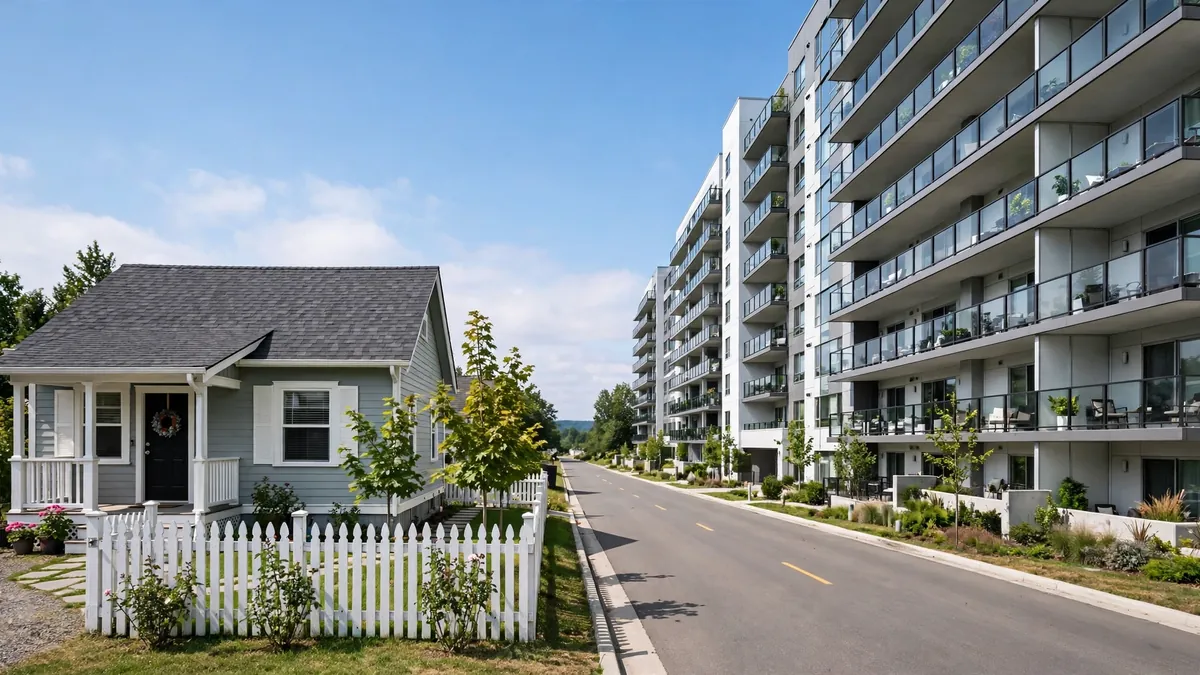
Title matters as much as door count. If you hold property in your own name or a single LLC, a personal umbrella may still work. If you hold title in several LLCs, a personal umbrella in your own name may not respond, because the named insured does not match the owner of the property. At that point you need a commercial policy that names each entity, or a master policy that covers all of them.
Personal vs commercial umbrella at a glance
| Personal umbrella | Commercial umbrella | |
|---|---|---|
| Built for | Individuals with a few rentals | Portfolios, LLCs, multifamily |
| Rental cap | 3 to 5 scheduled rentals | No fixed cap |
| Typical switch point | Up to 5 to 7 doors | Above 5 to 7 doors |
| Named insured | An individual | One or more entities |
| $1M cost | $150 to $350 a year | $800 to $3,500 per $1M a year for apartments |
If you are near the edge, do not guess. A broker who places landlord umbrellas every week can tell you in one call whether your portfolio still fits a personal policy. And if you rent out units you do not own, read our rental arbitrage guide first, because arbitrage hosts carry a different mix of lease and liability risk than owners do.
How much does landlord umbrella insurance cost in 2026?
For most small landlords, the cost is lower than expected. A personal umbrella runs $150 to $350 a year for $1M, $225 to $450 for $2M, and $525 to $750 for $5M. The Insurance Information Institute reported an average of $383 a year for a $1M personal umbrella in 2025, and those numbers hold for 2026 with slight inflation adjustments.
Personal umbrella cost, 2026
| Coverage limit | Typical annual cost |
|---|---|
| $1M | $150 to $350 |
| $2M | $225 to $450 |
| $5M | $525 to $750 |
| $1M, landlord policy for 1 to 3 rentals | $200 to $400 |
| Each extra $1M, landlord policy | $100 to $200 |
Notice the pattern: the first million costs the most, and each extra million costs less. That is why jumping from $1M to $2M is often the best value in the whole policy. The Insurance Information Institute notes the same trade-off: most insurers want you to carry at least $250,000 of auto liability and $300,000 of homeowners liability before they sell you a $1M umbrella, and the extra millions after the first come cheaper.
Commercial umbrella pricing scales differently. It is rated on total units or square footage and the risk profile of the portfolio, so two buildings with the same unit count can price very differently.
Commercial umbrella cost benchmarks, 2026
| Property | Coverage limit | Typical annual cost |
|---|---|---|
| 6-unit building | $2M | $800 to $1,400 |
| 200-unit property | $10M | $7,000 to $14,000 |
| 350-unit portfolio | $10M | $12,000 to $22,000 |
| Apartments, per $1M of coverage | $1M | $800 to $3,500 |
How much coverage do you need by portfolio size?
| Portfolio | Starting limit | Policy type | Typical annual cost |
|---|---|---|---|
| 2 to 10 units | $2M | Personal, if under the property cap | $300 to $500 |
| 11 to 50 units | $5M | Commercial | $2,000 to $5,000 |
| 51 to 200 units | $10M | Commercial | $7,000 to $15,000 |
| 200 units and above | $15M to $25M | Commercial | Priced per portfolio |
Use these starting points as a baseline. Your attorney or CPA should confirm the right number for your specific situation. Location, construction type, and loss history all move the price, and a building with prior claims will cost more than a clean one of the same size.
What do lenders require on multifamily properties?
Lenders and institutional partners commonly require a $5M umbrella on multifamily. Some require $10M or more, especially on larger complexes or portfolios with mixed use. If you are buying with financing, check the loan terms before you shop for the policy, because the lender requirement sets your floor. A policy that is perfect for your net worth is still wrong if it is below what the lender demands.

Worked example: a 4-property landlord
Take a landlord with 4 single-family homes, each worth $400,000, owned free and clear. That is $1,600,000 in property equity: 4 homes times $400,000. Add a retirement account and savings, and net worth sits in the $2M to $3M range. By the rule of thumb, carry at least as much coverage as net worth, so $2M is the floor here, not the ceiling.

A $2M personal umbrella for a portfolio this size typically costs $300 to $500 a year. Split across 4 doors, that is $75 to $125 per door per year. A $1M landlord umbrella for 1 to 3 rentals runs $200 to $400 a year, and each extra $1M adds $100 to $200, so the step from $1M to $2M is the cheapest extra protection this landlord will ever buy.
Now run a claim through the stack. Say a guest is badly hurt on a balcony and the jury awards $4.2 million, the same size as the California verdict above. The underlying landlord policy pays the first $300,000, because that is the per-occurrence limit the umbrella requires. The $2M umbrella pays the next $2,000,000. That leaves $1,900,000 unpaid: $4,200,000 minus $300,000 minus $2,000,000. The landlord pays that from equity and savings.
The same $4.2M claim under three limits
| Coverage | Underlying pays | Umbrella pays | Landlord still owes |
|---|---|---|---|
| $1M umbrella | $300,000 | $1,000,000 | $2,900,000 |
| $2M umbrella | $300,000 | $2,000,000 | $1,900,000 |
| $5M umbrella | $300,000 | $3,900,000 | $0 |
That table is the whole argument. The landlord with 4 doors and $2M of coverage still owes $1,900,000 after a $4.2M verdict. The same landlord with a $5M umbrella owes nothing on that claim, and the extra $3M of limit costs roughly $300 to $600 a year at $100 to $200 per extra million. If the portfolio grows past 5 doors, the personal policy stops fitting anyway, and the move to a commercial umbrella is the moment to reset the limit. Mid-term stays add one more wrinkle: a 30-day tenant is not a short-term guest and not a year-long tenant either, so check how your policy treats them in our mid-term rental strategy guide before you set the limit.
What are the 5 mistakes landlords make?
Most umbrella claims are denied for boring reasons, not dramatic ones. A property left off the schedule. An underlying limit set too low. An entity name that does not match. All five mistakes below are avoidable, and all five cost real money when they are not.

Mistake 1: unscheduled properties
Every rental must be listed on the umbrella declaration page. If you buy a new property and forget to add it, the umbrella will not respond to a claim on that property. Set a calendar reminder for every closing. Send the deed and policy declarations to your agent the same day you close, not at renewal.
Mistake 2: low underlying limits
Most umbrellas require $300,000 per occurrence of underlying liability on each landlord policy. If you carry $100,000 on a property, the umbrella will not drop down to fill the gap. It will leave a hole equal to the difference. Raise every landlord policy to at least $300,000. A $500,000 underlying limit is better and often costs only a few dollars more per month.
Mistake 3: forgetting short-term rentals
Airbnb, Vrbo, and similar platforms create different exposure. A guest injury in a short-term rental can trigger both premises liability and products liability if you provide amenities like bikes, kayaks, or hot tubs. Standard landlord policies often exclude short-term rental activity. You need a specific endorsement or a separate short-term rental policy that feeds into the umbrella. Do not assume your homeowners or landlord policy covers it. Our short-term rental insurance guide walks through what a host policy needs to include before the next guest arrives.
Mistake 4: wrong entity structure
If you hold title in an LLC but the umbrella is in your personal name, the insurer may deny coverage. The named insured on the umbrella must match the entity that owns the property, or that entity must be listed as an additional insured. If you have multiple LLCs, each one needs to be named, or you need a master policy that covers all entities. Talk to an attorney who works on asset protection before you restructure anything.
Mistake 5: never re-shopping
Umbrella pricing varies widely between carriers. A carrier that works a lot in habitational risk may charge half what a generalist charges for the same portfolio. Get quotes every two years. Use an independent broker who has access to more than one surplus lines market. The savings on a $10M commercial umbrella can run into thousands of dollars a year, which is a lot to leave on the table for the sake of a renewal you never questioned.
How do you buy landlord umbrella insurance in 5 steps?
Buying an umbrella is a paperwork job, not a sales job. The carrier wants clean records, and the broker wants clear answers. Bring both and the quote comes back fast.

Step 1: gather your data
Pull the declarations page for every landlord policy. List every property address, unit count, entity name, and current liability limit. Add up your total net worth, including real estate equity, retirement accounts, vehicles, and liquid assets. If you cannot list it, you cannot insure it.
Step 2: decide personal or commercial
Count your doors. If you are at 5 or fewer and the properties sit in your personal name or a single LLC, a personal umbrella may work. If you have multiple LLCs or more than 5 doors, go commercial. This is the decision that sets the limit, the price, and the paperwork, so settle it before you ask for quotes.
Step 3: find a broker who knows habitational risk
Ask how many landlord umbrellas they placed last year. Ask which carriers they use for $5M and $10M limits. Ask for a claims example they have handled. A good broker will walk you through the underlying limit requirements and the scheduling process without being asked, because they have seen what happens when those steps are skipped.
Step 4: compare quotes on the same basis
Make sure each quote shows the same underlying limit requirement, the same scheduled properties, the same excluded perils, and the same defense cost treatment. Defense inside the limit versus outside the limit changes the real value a lot. A cheaper quote that puts defense costs inside the limit can be the worse deal.
Step 5: bind and schedule
Once you choose a carrier, send the signed application and the updated declarations pages for every property. Confirm in writing that each property is scheduled. Save the binder and the schedule in your cloud storage and in your property management software. Set a reminder to review it at renewal, and another reminder to add any property you buy mid-term.
The bottom line
Landlord umbrella insurance is the cheapest large limit you will ever buy. A $1M landlord umbrella costs $200 to $400 a year for 1 to 3 rentals, and each extra $1M adds $100 to $200. If you own 4 or more doors or your net worth tops $1M, $2M is the floor, and the worked example above shows why: a $4.2M verdict leaves a landlord with a $2M umbrella owing $1,900,000, while a $5M umbrella covers the same claim in full.
Pick the right type first. Personal umbrellas cap at 3 to 5 scheduled rentals, and the switch to commercial usually comes around 5 to 7 doors. Then set the limit from your net worth, not from the premium. Then check the three things that cause denied claims: every property scheduled, every underlying policy at $300,000 or more, and the named insured matching the entity on the deed. Do those three, re-shop every two years, and the umbrella does its job quietly in the background, which is exactly where you want it.
Buy the limit for the verdict, not for the premium. A $4.2M claim is not a hypothetical in this guide, it is a real 2024 California jury award, and the table shows a $2M umbrella still leaves $1,900,000 unpaid. The step from $2M to $5M costs roughly $300 to $600 a year, which is the cheapest gap-closing money in the whole policy, and it only works if every property is scheduled and every underlying policy sits at $300,000 or more.
Frequently asked questions
How do I know if I need a commercial umbrella instead of a personal one?
Count your rental doors. If you have more than 5 or if title is held in multiple LLCs, you almost certainly need a commercial umbrella. Personal umbrellas typically cap at 3 to 5 scheduled rentals and require the named insured to be an individual.
What underlying limit do I need on each landlord policy?
Most umbrellas require $300,000 per occurrence. A $500,000 limit is safer and often costs only a few dollars more per unit per month. Never go below $300,000 or the umbrella will not attach.
Does an umbrella cover my tenant discrimination claim?
No. Discrimination claims fall under professional liability or employment practices liability. You need a separate policy for that exposure. An umbrella covers third-party bodily injury, property damage, defamation, libel, slander, invasion of privacy, and defense costs.
Can I add a new property to my umbrella mid-term?
Yes. Contact your broker immediately after closing. Most carriers allow mid-term endorsements for a pro-rated premium. Do not wait until renewal. A claim on an unscheduled property will be denied.
Want more practical guides like this?
Browse all 112 guides across 10 categories, no fluff, no paywall.
Browse all guides →Explore Insurance guides