Short-Term Rental Insurance 2026: What Every Host Must Have Before the Next Guest Arrives
Airbnb now asks hosts to carry their own primary liability insurance, and a standard homeowners policy usually does not cover rental activity at all. Here is what platform protection really covers, what short term rental insurance costs, and the checklist to buy the right one before your next booking.
The short answer: if you rent a property short term, you need a purpose-built short-term rental policy with at least 1 million dollars of commercial liability coverage, plus guest damage and loss of income protection. Platform programs like Airbnb AirCover help, but they are not insurance and they cover only bookings on that platform.
Key numbers at a glance
- 3 million dollars is Airbnb AirCover host damage protection, and 1 million dollars is its host liability insurance per stay, but Airbnb itself says the damage protection is not an insurance policy
- 1 million dollars is Vrbo liability protection only, with no guest property damage cover at all
- 1,000 to 3,500 dollars per year is the typical range for a dedicated short-term rental policy per property, higher for pools, hot tubs, coastal homes, and high-value properties
- 14 days is the AirCover filing window for damage claims, miss it and you lose the claim
- 500,000 to 1 million dollars of liability insurance is now required for permits in at least seven major US cities, with enforcement ramping up in 2026
- 300,000 dollars is the liability minimum Oneida County, New York set for registered short-term rentals from January 1, 2026
- 6 or more listings is the point where Airbnb host liability insurance stops acting as the first policy to respond, under its March 2025 program change
- 2,000 to 3,000 dollars per year is the standalone STR policy range reported in a 2026 operator guide, before location and amenity adjustments
- 200 dollars a month is the monthly equivalent of a 2,400 dollar annual premium in the guide's cost math, against one bad month of guest damage
- The first 48 hours win or lose a claim: photograph damage before cleaning, message the guest through the platform, and file inside the platform window
Marcus rents out two houses in Austin, Texas. One is his old family home, the other he bought in 2023 as a dedicated rental. For three years he paid his regular homeowners premiums on time, kept the houses clean, and never thought much about insurance. Then a guest slipped on a wet step in March, broke a wrist, and hired a lawyer. Marcus filed with his homeowners carrier, confident he was covered. The carrier denied the claim. The policy covered his home, not a commercial rental business, and the injury happened during a paying stay. The medical bills and legal letters landed on Marcus, not on his insurer. He fixed the step, paid a settlement out of pocket, and bought a real short-term rental policy the same month. His only regret, in his words, was waiting for a claim to learn what his policy actually said.
Marcus is not careless. He is typical. Most hosts start with a homeowners policy, add a platform listing, and assume the platform covers the rest. Both assumptions are wrong in the same direction: they leave the host holding the risk. This guide fixes that, with the 2026 rule changes, a plain comparison of platform protection against a real policy, real cost ranges, and a shopping checklist you can run this week. If you are still choosing the rental itself, read our short-term rental guide and our direct bookings playbook first, because the insurance you need changes once bookings come from your own site instead of one platform.

Why does a homeowners policy fail hosts?
A standard homeowners policy is written for a home you live in, not for a business that rents beds by the night to strangers. Once paying guests rotate through, most carriers treat the property as commercial activity, and commercial activity is usually excluded.
Short-term rental insurance is a purpose-built policy that treats guest stays as commercial activity and covers liability, guest damage, and loss of rental income across every booking channel.
The Insurance Information Institute, known as Triple-I, made this plain in a March 2026 outlook report: standard homeowners insurance typically does not cover losses that result from commercial activity, and under virtually every standard policy, short-term rentals count as commercial activity. That one sentence explains most host claim denials. It is not a loophole the carrier invented after your claim. It is the policy working as written, for a risk it was never priced to cover.
The failure shows up in four ways, and hosts usually discover them together, at the worst moment. First, a guest damage claim gets denied because the damage happened during rental activity. Second, liability cover shrinks or disappears when a guest is hurt, because the injury happened in a commercial operation, not a private home. Third, loss of use cover, the part that pays while a damaged home cannot be rented, can be voided if the home becomes uninhabitable after an uncovered loss. Fourth, and most quietly damaging, the carrier can cancel or refuse to renew the policy once it learns the home has been rented commercially without notice. A host who never told the carrier can lose cover for everything, including a fire or storm that has nothing to do with guests.
Some carriers offer a home-sharing endorsement or rider, and that is better than nothing. Read it closely before you rely on it. Many riders cap rental days, cap liability, or cover only occasional rentals, not a full-time listing. A rider that covers 30 rental nights a year does not protect a house rented 200 nights a year. If your listing runs most weekends, a rider is a bandage, not a policy. Tell your carrier you host, in writing, and get the answer in writing too. A verbal "you should be fine" from an agent is worth nothing at claim time.

What changed for hosts in 2026?
Three changes in 2025 and 2026 moved the risk from the platform to the host, and hosts who missed them are the ones most exposed now.
The first change is in Airbnb's own terms. Updated terms include a new host section, Section 5.7, called "Your Insurance Obligations," which did not exist in the previous version. For hosts under Airbnb's main terms, including in the United States, it says you agree to carry primary liability insurance at your own expense, covering your liability and that of your employees or agents for third-party bodily injury and property damage arising from a guest stay. Primary means your policy answers first. Airbnb's cover, where it applies, sits behind yours. That is a real shift in who pays first when a guest is hurt.
The second change hits larger hosts. Since March 1, 2025, Airbnb's host liability insurance program has carved out hosts with six or more active listings at the time of a loss. If you run six or more listings, do not assume Airbnb liability cover will step in first. For professional managers and multi-property hosts, this is the clearest possible signal: you need your own commercial policy, and it needs to list every property and every listing.
The third change is local, and it is spreading. At least seven major US cities now require 500,000 to 1 million dollars in liability insurance for short-term rental permits, with enforcement ramping up in 2026. Oneida County, New York, which built a rental registry under Local Law No. 1 of 2025, requires registered hosts to carry at least 300,000 dollars in liability insurance from January 1, 2026, and it folds rentals into the county hotel and motel occupancy tax. Idaho went the other way with HB 583, barring local governments from requiring STR-specific insurance beyond standard homeowner cover, which shows the patchwork hosts now face: the rule depends on your city and county, and it can change in either direction. Check your permit rules before you renew, not after an inspector asks.

How does platform protection compare with a real policy?
Platform protection is useful, and you should use all of it. It is not a substitute for insurance, and the table below shows why in one glance.
Key facts: platform protection vs a dedicated STR policy
| Cover | Airbnb AirCover | Vrbo protection | Dedicated STR policy |
|---|---|---|---|
| Guest damage to your property | Up to 3 million dollars, but Airbnb says it is not an insurance policy, and claims must be filed within 14 days | Not covered at all | Yes, up to the policy limit, for all bookings on all platforms |
| Guest injury liability | Up to 1 million dollars per stay, with a long exclusion list, and a carve-out for hosts with 6 or more listings | Up to 1 million dollars liability only, with exclusions for unpermitted properties and alcohol-related incidents in some cases | Yes, commonly 1 million dollars per occurrence, as your primary cover |
| Direct and other-platform bookings | No, Airbnb stays only | No, Vrbo stays only | Yes, the property is covered, not the booking channel |
| Loss of rental income | Limited, tied to damage on an Airbnb stay | Generally no | Yes, if the policy includes loss of income or loss of rents |
| Fire, storm, and theft | No, natural disasters like flood and earthquake are excluded from the damage program | No | Yes, under the property section, subject to the policy terms |
| Cost | Free with hosting | Free with hosting | Typically 1,000 to 3,500 dollars per year per property |
Read the exclusions before you trust the headline numbers. AirCover damage protection excludes natural disasters, and its liability program excludes a long list of situations, including assault and battery claims and punitive damages where the law does not allow them to be insured. Vrbo protection is narrower still: it is liability only, so a guest who floods your bathroom or breaks your furniture leaves you with no Vrbo reimbursement at all. Both programs end at the edge of their own platform. A guest who books direct through your website, which is exactly the booking every experienced host wants more of, is covered by neither.
The right way to think about it is layers, not either-or. Keep AirCover and Vrbo protection switched on, file claims inside their windows, and buy a dedicated policy underneath them as the real cover. That layered setup is what the better host guides now recommend: platform protection for routine guest damage, a dedicated policy for liability and catastrophic loss, and a damage protection plan or deposit for the small stuff that is not worth a claim. Our direct bookings guide explains why that last layer matters more every year, because direct bookings bypass platform protection entirely.

What should a good STR policy cover?
A good short-term rental policy covers the property, the people in it, and the income it earns, on every booking channel, with limits that match your permit and your worst realistic claim.
Start with commercial general liability, commonly 1 million dollars per occurrence and 2 million dollars aggregate. That is the line that answers when a guest is hurt, a visitor trips on your steps, or a neighbor claims your guests damaged their property. Match it to your permit: if your city requires 1 million dollars, a 500,000 dollar limit leaves you non-compliant even if it feels generous. If you have a pool, hot tub, trampoline, or rooftop deck, say so on the application. Those amenities raise premiums, but hiding them can void a claim, which is far more expensive than the premium.
Next, property cover that is written for rental use: the building, your furniture and contents, and guest-caused damage without a small sub-limit that makes the cover useless. Some policies cap guest damage far below the headline limit, so ask for the guest damage sub-limit in writing. Then loss of income, also called loss of rents: if a burst pipe or a fire takes the house offline for two months, this pays the rent you would have earned. Hosts who skip this cover discover the second cost of a claim, which is the empty calendar, not just the repair bill.
Then the extras that separate a real STR policy from a landlord policy with a rental label. Bed bug treatment cover, with a stated limit, because one infestation can cost thousands and close a listing for weeks. Squatter and vandalism protection, because a guest who refuses to leave is a legal problem before it is an insurance problem, and the policy should say how it responds. Liability for events you allow, like small gatherings, if you allow them at all, and clear wording on pets, smoking, and parties, since those three rules drive a large share of damage claims. If a policy will not put bed bug and loss of income limits in plain numbers, keep shopping.

What does STR insurance cost?
Expect 1,000 to 3,500 dollars per year per property for a dedicated policy, with a 2026 operator guide putting the typical standalone range at 2,000 to 3,000 dollars. That range is wide because the price follows the property, not the host. A one-bedroom condo in a low-risk city costs far less than a five-bedroom coastal house with a pool and a hot tub, and both cost more than a landlord policy for the same building, because the risk is genuinely higher: more strangers, more turnover, more chances for something to go wrong.
Five factors move your quote most. Location, including storm, wildfire, and flood exposure, and whether your city requires a permit with a minimum limit. Replacement value of the building and contents, because a policy that rebuilds a 900,000 dollar house costs more than one that rebuilds a 300,000 dollar condo. Amenities, especially pools, hot tubs, fire pits, and waterfront access, which raise liability risk. Rental volume, meaning nights rented and number of listings, because a full-time listing is a business, not a side hobby. And claims history, including any denied homeowners claim, which is why telling your carrier early matters: a clean switch to a proper policy beats a denial on your record.
Do the math against one bad month, not against zero. A 2,400 dollar annual premium is 200 dollars a month. One denied guest injury claim can cost ten times that in legal fees alone, before any settlement. One month of lost rent after an uncovered water loss can cost more than a year of premiums. Hosts who treat insurance as a cost to minimize usually minimize it in the wrong place, by cutting liability limits or dropping loss of income. Cut costs the safe way instead: raise the deductible you can actually afford, bundle multiple properties with one carrier, install the safety items carriers discount, like smoke detectors, water leak sensors, and a locking pool gate, and keep a clean claims record by handling small guest damage through deposits and damage plans rather than claims.
Key facts: short-term rental insurance cost math
| Figure | Value |
|---|---|
| Typical dedicated STR policy | 1,000 to 3,500 dollars per year per property |
| Standalone range in a 2026 operator guide | 2,000 to 3,000 dollars per year |
| Monthly equivalent of a 2,400 dollar premium | 200 dollars per month, against one bad month of lost rent or legal fees |
| Permit liability minimums in major cities | 500,000 to 1 million dollars in at least seven major US cities |
| AirCover damage filing window | 14 days from the damage or loss |
| Airbnb primary insurance rule | Hosts must carry their own primary liability insurance under Terms Section 5.7 |

How do you shop for the right policy?
Get three quotes, and compare them on the same sheet, not on price alone. Start with a specialty STR carrier or broker, because general home insurers often do not write true STR cover, and a broker who places STR policies weekly will know which carriers accept your property type, your city, and your amenities. Names hosts commonly compare include Proper Insurance, a specialty commercial STR policy, CBIZ Vacation Rental Insurance, Steadily for mixed STR and long-term portfolios, and Safely for per-stay cover that plugs into property management tools. Compare their published limits, not their marketing, and ask each one the same ten questions, in writing.
Ask: what is the liability limit per occurrence and in aggregate, and does it meet my permit? What is the guest damage sub-limit, and does it cover intentional damage or only accidental damage? Is loss of income included, for how many months, and at what rent basis? Are bed bugs covered, to what limit, and with what deductible? Does the policy cover all booking channels, including direct bookings, or only named platforms? Are pools, hot tubs, pets, and events covered, and what safety conditions apply? What is excluded, in full, not in summary? What is the deductible for property, for liability, and for bed bugs separately? How are claims filed, and what is the deadline? And does the policy replace my homeowners policy, sit beside it, or require the homeowners policy to be cancelled?
That last question matters more than hosts expect. A specialty commercial STR policy usually replaces the homeowners policy entirely, because the property is now a commercial property. A landlord policy with an STR endorsement sits in a middle ground that works for some hosts and fails for others. Running both a homeowners policy and an STR policy on the same property without telling either carrier is the worst setup: each carrier can point at the other, and both can deny. One property, one clear primary policy, everything disclosed, in writing. If a broker cannot explain how the policies fit together in one paragraph, find another broker.
For hosts who rent only occasionally, per-stay cover is worth pricing. Safely-style per-booking protection charges by the stay and can suit a host who rents a few weekends a year, while a dedicated annual policy suits a full-time listing. Do not buy per-stay cover for a full-time listing to save money: the per-stay cost overtakes the annual premium quickly, and the cover is usually narrower. The same logic applies in reverse: an occasional host does not need the most expensive annual policy on the market. Match the policy to the nights you actually rent, then re-price it when the volume changes.
What do you do when something goes wrong?
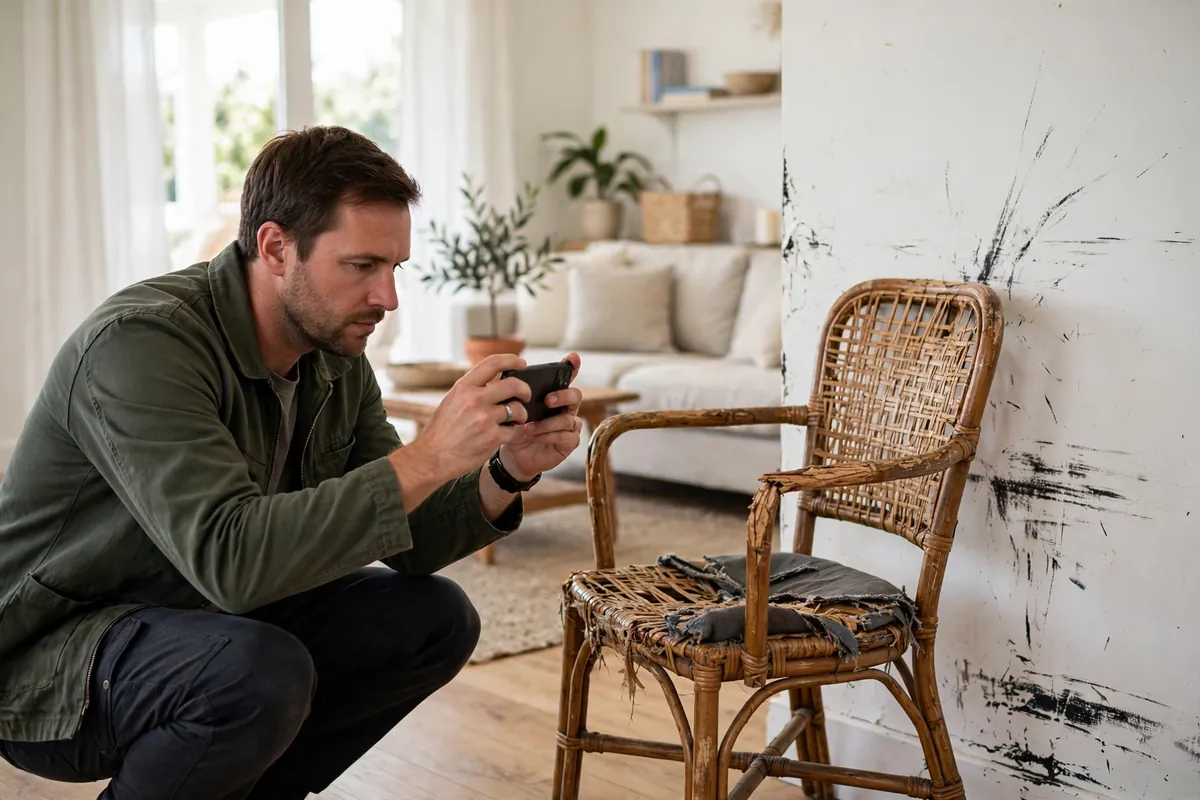
Claims are won in the first 48 hours, with photos and timestamps, not in the argument weeks later. Build the habit now, while nothing is broken. Photograph every room between stays, or use a turnover checklist with dated photos, so you can prove the condition before the guest arrived. Keep receipts for furniture and appliances, keep the booking record, the house rules the guest accepted, and every message about the damage in one place. When damage happens, photograph it before cleaning, message the guest through the platform so there is a written record, and file with the platform inside its window, 14 days for AirCover, even if you also plan to claim on your own policy.
For an injury, the order is different: help first, paperwork second, and never admit fault in writing. Call emergency services if needed, make the property safe, take photos of the scene as you found it, and notify your insurer the same day, even if you are not sure the claim will proceed. Early notice protects you if the guest hires a lawyer months later, because late notice is a common reason carriers fight claims. Keep every guest message, every cleaner note, and every repair invoice, and let the insurer and, if needed, a lawyer handle the guest conversation from that point. Hosts who try to settle injury claims privately, with cash and a handshake, usually regret it when the same guest comes back with a larger demand.
For small damage, use the deposit or damage plan first and save the insurance claim for the big event. A broken lamp, a stained towel, or a scuffed wall is a cost of hosting, and claiming it raises your premium or counts against your claims history. A flooded bathroom, a broken bed frame, or a guest who smoked through a no-smoking house and left a deep cleaning bill is a claim conversation. The rule of thumb: if the cost is less than twice your deductible, pay it yourself and move on. Insurance is for the loss you cannot absorb, not for the mess you can.
What mistakes do hosts keep making?
The first mistake is silence: never telling the homeowners carrier about renting. The second is trusting platform protection as if it were insurance, especially on Vrbo, where damage is not covered at all. The third is buying on price alone and discovering a 5,000 dollar guest damage sub-limit after a 12,000 dollar claim. The fourth is forgetting direct bookings, which is ironic, because direct bookings are the goal of every serious host guide, including our rental arbitrage guide, where the lease and the landlord need to be part of the insurance conversation too. The fifth is letting cover lapse between policies, even for a week, because a claim in a gap week is an uninsured claim.
Two more mistakes deserve a line each. One, hosts who rent a property they do not own, through rental arbitrage, sometimes buy a policy that covers the owner, not themselves, or buy nothing because the owner has a policy. Arbitrage hosts need their own liability and contents cover, plus a lease clause that allows short-term renting and names who insures what. Two, hosts who add a pool, hot tub, or bunk room mid-year and forget to tell the carrier. A mid-year amenity change is a mid-year disclosure, not a renewal note. Update the policy the week you install it, not at renewal.
What is the host insurance checklist?
Run this list before your next guest, and again at every renewal. One, tell your current carrier you host, in writing, and keep the reply. Two, confirm your permit liability minimum and buy at least that limit, preferably 1 million dollars per occurrence. Three, buy a dedicated STR policy that covers all booking channels, including direct bookings. Four, confirm guest damage, loss of income, and bed bug limits in plain numbers, not summaries. Five, disclose pools, hot tubs, pets, events, and the true number of rental nights. Six, set a deductible you can pay from one month of rent, not from savings you do not have. Seven, photograph the property between stays and keep a turnover record. Eight, file platform claims inside their windows, and notify your own insurer the same day for any injury. Nine, calendar the renewal and the permit renewal together, so cover never lapses in a gap week. Ten, re-price the policy when you add a property, an amenity, or a booking channel.
Marcus, the Austin host from the start of this guide, now runs that checklist every January. His premium is 2,600 dollars a year across his two houses through one carrier, which is about 108 dollars per house per month. He photographs turnovers, he files small damage through deposits, and he has not had a denied claim since. The insurance did not make hosting risk-free. Nothing does. It made one bad guest a bad week instead of a bad year, which is exactly what insurance is for.

The bottom line
Buy the dedicated policy before the next guest, not after the next claim. A homeowners policy does not cover commercial rental activity, platform protection stops at the platform edge and, on Vrbo, stops before property damage entirely, and Airbnb now puts primary liability insurance on the host in its own terms. A policy in the 1,000 to 3,500 dollar range, with 1 million dollars of liability, real guest damage cover, and loss of income protection, is the cheapest way to keep one guest, one injury, or one flood from becoming the story of your hosting business.
Shop the policy on three claims, not on price alone: guest damage, liability, and the permit check, because the cheapest premium that fails any one of those three is the most expensive policy a host can buy.
Frequently asked questions
Does Airbnb AirCover replace short-term rental insurance?
No. AirCover host damage protection is not an insurance policy by Airbnb's own description, it covers Airbnb stays only, and it must be claimed within 14 days. You still need your own policy for liability, for direct and Vrbo bookings, and for property risks like fire and storm.
Will my homeowners policy cover my Airbnb?
Usually not for rental activity. Standard homeowners policies are written for a home you live in, and the Triple-I March 2026 report says they typically do not cover losses from commercial activity, which includes short-term rentals. Some carriers offer a limited home-sharing rider, but it often caps rental nights and liability, so read it before you rely on it.
How much does short-term rental insurance cost?
Typically 1,000 to 3,500 dollars per year per property, with a 2026 operator guide putting the standalone range at 2,000 to 3,000 dollars. Pools, hot tubs, coastal locations, high-value homes, and full-time rental volume push the price up, while higher deductibles and safety items like leak sensors can bring it down.
What liability limit should a host carry?
At least 1 million dollars per occurrence is the sensible default, and it matches the permit minimum in several major cities. Check your own city and county rules first, because some require 500,000 dollars and some require 1 million, and a limit below your permit minimum leaves you non-compliant.
Do I need insurance for direct bookings?
Yes, and this is the gap most hosts miss. Platform protection covers only stays booked on that platform, so a direct booking through your own website has no AirCover and no Vrbo protection. A dedicated STR policy covers the property on every channel, which is why it matters more as direct bookings grow.
Want more practical guides like this?
Browse all 104 guides across 10 categories, no fluff, no paywall.
Browse all guides →Explore Insurance guides