AI Voiceover Work 2026: How to Earn $20 to $115 Per Finished Minute
AI voiceover work 2026 pays $20 to $115 per finished minute, and AI tools now handle the voice while you handle the judgment. Here is the setup, the rates, the clients, and a 30-day plan to your first paid job.
Yes, AI voiceover work pays in 2026, but it pays for a service, not for pressing a button. Professional narration rates run roughly $20 to $115 per finished minute, checked November 4, 2026. Top earners sell a product, not raw AI audio: a script shaped for the ear, a voice matched to the brand, clean audio, and delivery on time.
Key numbers at a glance
- Pro narration rates, checked Nov 4 2026:$20 to $115 per finished minute
- ElevenLabs Starter plan:$6 a month ($5 a month billed annually)
- ElevenLabs Creator plan:$22 a month ($18.33 a month billed annually)
- ElevenLabs Pro plan:$99 a month ($82.50 a month billed annually)
- ElevenLabs free plan:10,000 credits, no commercial licence
- Murf Creator plan:$19 a month billed annually, $29 month to month
- Murf Creator voice generation:24 hours a year, commercial rights included
- Murf Business plan:$66 a month billed annually
- Upwork freelancer service fee:0 to 15 percent per contract
- Median side hustle income, Bankrate 2025 survey:$200 a month
- Average side hustle income, same survey:$885 a month
- US adults with a side hustle, Bankrate 2025:27 percent
- AI training work, DataAnnotation advertised rate:up to $50 an hour
- One 10-minute lesson:$500 at $50 per finished minute
- 60-second YouTube voiceover:$50 to $150 per job
- 5-minute explainer voiceover:$150 to $400 per job
Last reviewed: November 2026.
Every YouTube channel, online course, audiobook, and ad needs a voice. A few years ago that meant hiring a voice actor and booking studio time. Today an AI voice can read a script in minutes, in dozens of tones, in dozens of languages. The work did not disappear. It moved. The money now goes to the person who turns a script into finished audio a client can publish without touching it.
That person can be you, and the start is cheaper than most side hustles. A decent microphone costs less than $100. The AI tools start free. The skill is not the voice, it is the ear: knowing when a sentence sounds flat, when a pause is too long, and when a word needs emphasis. If you have ever re-recorded a video three times because the audio sounded wrong, you already have the instinct.
This AI voiceover work 2026 guide covers what the work actually is, what it pays, which tools to use and what they cost, how to set up a studio for under $150, where clients hire, and a 30-day plan to your first paid job. No income promises. Most side hustles earn little at first, and some earn nothing. The numbers here are checked rates, not guarantees.
What AI voiceover work actually is
AI voiceover work is a production service, not a voice rental. A client sends you a script and a goal, such as a course lesson, a product video, or an audiobook chapter. You pick the voice, shape the script for listening, generate the audio, clean it up, and deliver a finished file. The client pays for the finished file, not for the minutes the AI spent talking.
There are four kinds of jobs, and they pay very differently. Narration for courses and audiobooks pays per finished minute, and it is the steadiest work. Explainer and YouTube videos pay per project, often $50 to $300 for a short video. Commercials and ads pay the most per minute but are the hardest to win. IVR and phone prompts pay per script and are the most boring, which is exactly why they are easy to win.
The work splits into two parts. The first part is the voice itself, which the AI handles. The second part is everything around it, which you handle: fixing scripts that were written to be read, not heard. A sentence with three commas and a semicolon looks fine on a page and sounds terrible out loud. Your job is to catch that before the client does.
One thing to be clear about: you are not replacing voice actors, and you should not pretend to be one. Clients who want a human performance will hire a human. Clients who want a clear, consistent voice at a low price, delivered fast, will hire you. Those are different markets, and the second one is large and growing. Our AI side hustles tested guide tried six AI income ideas over 30 days, and voice services were among the few that produced real client work instead of just signups.

What AI voiceover work pays in 2026
Rates are quoted per finished minute, which means a minute of audio the client can use, not a minute of your time. A 10-minute course lesson at $50 per finished minute pays $500. The same lesson might take you two hours to produce when you are new, and 45 minutes when you are good. The rate stays the same. Your speed is your raise.
Professional narration rates run roughly $20 to $115 per finished minute, checked November 4, 2026. The low end is short-form web content and bulk work. The high end is audiobooks, e-learning for companies, and medical or technical narration where a mispronounced word costs the client real money. A beginner should expect the low end for the first few jobs, then move up as reviews accumulate.
Per-project pricing is more common for video work. A 60-second YouTube voiceover often sells for $50 to $150. A 5-minute explainer video voiceover often sells for $150 to $400. A full audiobook chapter can sell for $200 to $600 depending on length. The pattern is the same: the client pays for a finished file, and the price reflects the length, the difficulty, and your track record.
Put the numbers next to the Bankrate 2025 side hustle survey to keep them honest. The survey of 2,616 US adults found 27 percent had a side hustle, and the median earner made $200 a month while the average was $885. A small group of high earners pulls the average up. One finished-minute job at $50 can beat the median month, and three or four a month can beat the average. It takes time to get there, and the first month is usually the slowest.
Do not price by the hour. Clients cannot compare an hourly rate for a service they do not understand, and you will be punished for getting faster. Price per finished minute or per project, and state the revision policy in the same line: one round of small fixes included, full re-reads charged extra. That single sentence prevents most arguments.

The tools you need (and what they cost)
Two tools do most of the work in this market, and both have free tiers you can learn on before spending anything.
ElevenLabs is the most used voice AI for this work. The free plan gives 10,000 credits with no commercial licence, which is enough to learn and to make demo samples. The Starter plan is $6 a month, or $5 a month billed annually, and it adds a commercial licence. Creator is $22 a month, or $18.33 a month billed annually, and Pro is $99 a month, or $82.50 a month billed annually. Prices were checked November 9, 2026. The quality gap between the free voices and the paid voices is small, but the licence gap is not: never sell work made on the free plan.
Murf is the second tool worth knowing. The Creator plan is $19 a month billed annually, $228 a year, or $29 a month if you pay monthly. It includes 24 hours of voice generation a year and commercial rights. The Business plan is $66 a month billed annually. Murf is simpler to learn than ElevenLabs, and its studio layout suits beginners who want to see the script and the audio side by side.
You also need an audio editor. Audacity is free and does everything a beginner needs: noise removal, volume leveling, cutting pauses, and exporting MP3 and WAV. Descript is a paid option that edits audio by editing text, which suits people who think in words rather than waveforms. Do not buy a paid editor until you have finished five paid jobs in Audacity. The free tool is not the limit. Your ear is.
One cost people forget is the voice itself. Some platforms charge per character or per minute of generated audio, and a long script with many retakes can eat your credits. Generate in short sections, and proof the script before you generate anything. A clean script means fewer retakes, and fewer retakes mean the free tier lasts longer.
The setup: a studio that costs less than $150
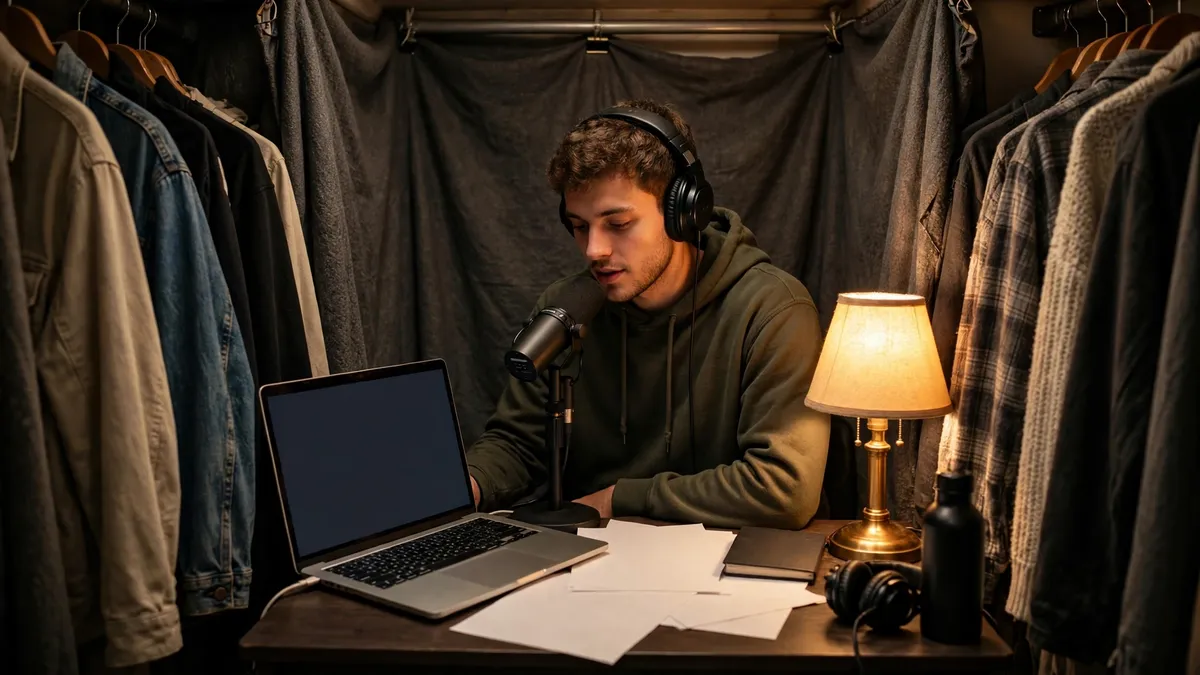
You do not need a treated room. You need a quiet corner and soft surfaces. Sound bounces off hard walls and gets absorbed by soft ones, so a closet full of clothes is a better studio than an empty spare room. That is not a joke. It is the cheapest acoustic treatment that exists.
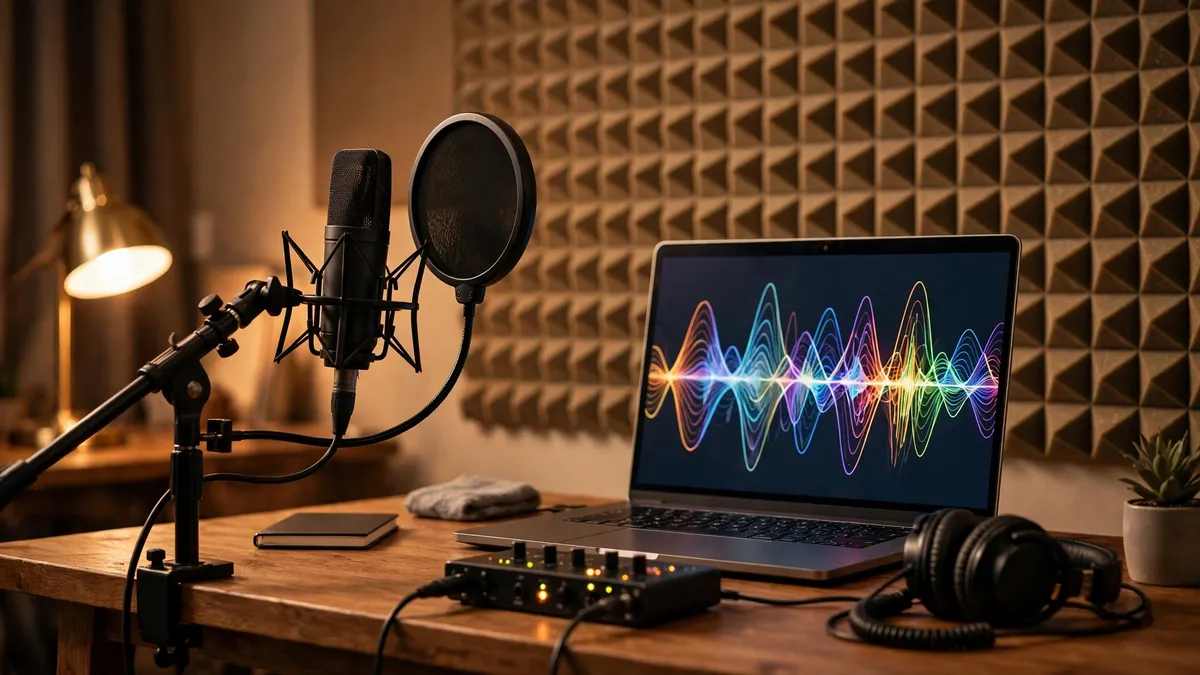
The microphone matters more than anything else in the chain. A USB condenser microphone in the $70 to $100 range is enough to start. The Samson Q2U and the Audio-Technica ATR2100x are common picks because they work over USB and XLR, so they grow with you. A pop filter costs about $10 and stops the hard P sounds that ruin a take. A boom arm costs about $25 and keeps the mic off the desk, which kills the thump when you move.
Record in the quietest part of your day, close the windows, turn off the fan, and put your phone on silent. Record a 10-second room tone, just the silence of the room, before you start. Your editor can use that silence to remove background noise from the whole file. Keep the microphone 15 to 20 centimeters from your mouth, slightly off to one side, and speak at a normal volume. Shouting into the mic is the most common beginner mistake, and it sounds worse than a quiet take every time.
Test the setup before you take a client. Record 60 seconds, listen back on headphones, and fix what you hear: echo means more soft surfaces, hiss means a gain setting that is too high, pops mean the filter is too far away. A setup that sounds clean on headphones will sound clean to a client. Our get paid to train AI guide covers another way to earn from AI work with no equipment at all, if you want to compare the two before you spend anything.
Where clients hire for AI voiceover work
Clients hire in three places, and each one needs a different approach.
Freelance marketplaces are where most beginners start. Upwork and Fiverr both have voiceover categories, and AI-assisted voice work sells there when you are honest about the method. List the service as AI voiceover, show samples, and price per finished minute. Upwork takes a service fee of 0 to 15 percent per contract, and you see it before you send a proposal. The first three jobs are the hardest to win, because you have no reviews. Price them low, deliver fast, and ask for a review in the same message as the delivery.
Direct outreach is where the better money is. YouTube channels with 10,000 to 100,000 subscribers often need regular narration and cannot afford a full-time voice actor. Online course creators need lesson audio. Small agencies need a reliable voice for client videos. Find ten channels or creators whose audio is weak, send each one a 30-second sample of their own script read in an AI voice, and offer a paid trial. One yes out of ten is a good hit rate, and one regular client can fill a month.
Content platforms are the slow lane. Audiobook marketplaces, e-learning platforms, and stock audio sites pay less per job but can produce repeat work. They are worth joining once you have samples, because they bring clients to you instead of the other way around. Do not build your whole business on them, because the platform sets the price, not you.
Wherever you look, the same rule applies: the client is buying reliability, not a voice. Answer fast, deliver on the day you promised, and fix small mistakes without arguing. A client who trusts you will come back, and a returning client is worth ten new ones.
Your demo reel is your resume
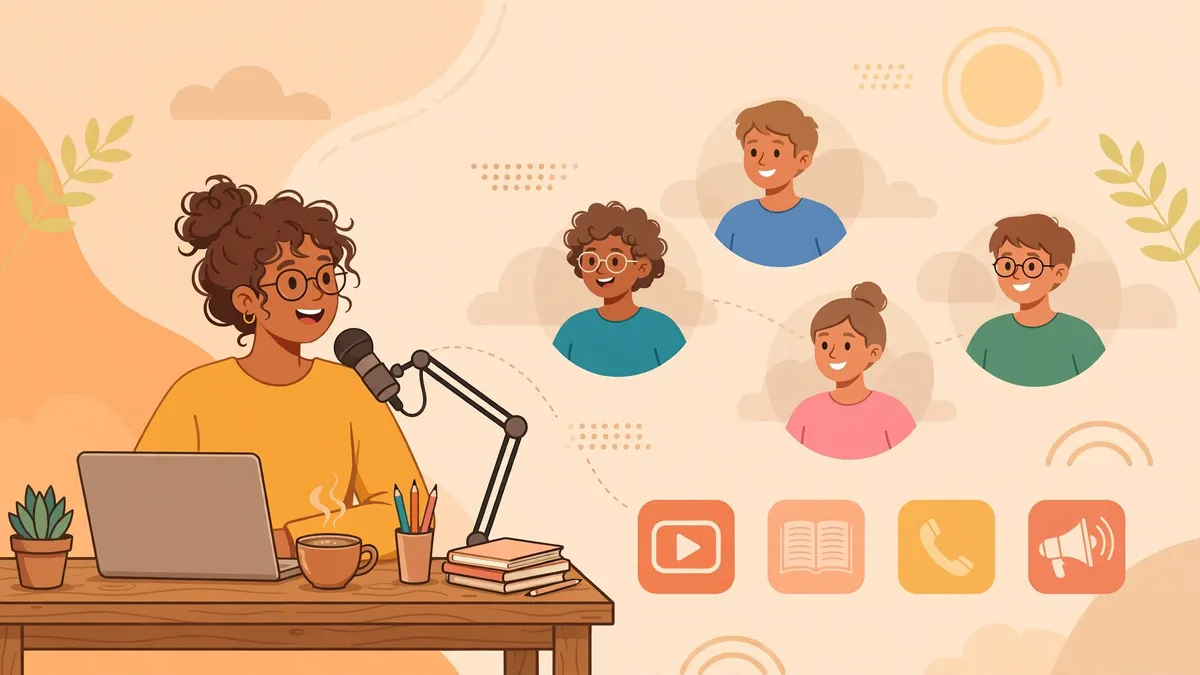
No client hires a voiceover service without hearing it first. Your demo reel is a 60 to 90-second audio file with four or five short samples: a course lesson, a product ad, a story excerpt, and a corporate explainer. Each sample should be 15 to 20 seconds, and each should sound like a different job. One voice reading four scripts in the same tone is not a reel, it is a recording.
Make the samples with real scripts, not made-up ones. Take a paragraph from a public domain book for the story sample. Rewrite a real product page for the ad sample. Use a lesson from a free course for the e-learning sample. Real scripts sound real, and clients can hear the difference.
Host the reel where clients can play it without downloading anything. A simple page with an audio player works. A Fiverr or Upwork gig with the reel attached works too. Put the reel link in every proposal, every profile, and every outreach email. A client who has to ask for a sample has already moved on to the next seller.
Update the reel every time you finish a job you are proud of. Replace the weakest sample with the new work. After ten jobs, the reel will sound like a working professional, because it is one.
5 services to sell first
Five services sell well for beginners because clients already understand them and the work is easy to scope.
1. YouTube narration. A creator sends a script, you deliver clean audio. Price per finished minute, and offer a small discount for a weekly slot. One channel that publishes twice a week is a steady client.
2. Course and e-learning narration. Course creators need consistent audio across dozens of lessons. The work is longer, the pay is steadier, and the client cares about consistency more than drama. This is the best first niche if you want regular income.
3. Audiobook chapters. Independent authors need chapters narrated, and many cannot afford a human narrator for a full book. Offer a per-chapter price with a sample of the first chapter free. The author can hear the voice on their own words before committing.
4. Commercials and ads. Short, punchy, and better paid per minute than anything else. The work is harder to win because the client has a strong opinion about the sound, but one good ad can lead to a whole campaign.
5. IVR and phone prompts. Businesses need a voice for their phone menu and on-hold messages. The scripts are short, the work is quick, and nobody else wants to do it. It is the easiest first sale in this list.
Pick one service and sell only that for the first month. A seller who does one thing well gets hired faster than a seller who does five things badly. Add the second service only after the first one has five reviews.
The pitfalls: licences, disclosure, and voice cloning
Three pitfalls end more voiceover side hustles than bad audio does, and all three are avoidable.
The licence trap. The free plan of most voice tools does not include a commercial licence. Work made on a free plan cannot legally be sold. The ElevenLabs free plan gives 10,000 credits with no commercial licence, and the Starter plan at $6 a month adds one. Never deliver client work from a free account. The $6 is the cheapest insurance in this business.
The disclosure trap. Some clients do not want their audience to know the voice is AI, and some platforms require disclosure. Say it plainly in your gig description and in the first message: this is AI-assisted voice work. Clients who are fine with it will hire you. Clients who are not will not, and that is better than a refund request and a bad review after delivery.
The voice cloning trap. Cloning a real person's voice without their written consent is off limits, and in some US states it is illegal. Never clone a celebrity, a client, or a colleague as a demo or a joke. Use the stock voices the platform provides, or a voice you have written permission to use. The Federal Trade Commission cracked down on AI-powered online store schemes in September 2024 under Operation AI Comply, and the same honesty standard applies here: sell what you actually did, and do not fake results or reviews.
One more trap is quieter: promising a delivery time you cannot meet. AI generation is fast, but editing is slow. A 10-minute lesson takes about an hour to edit well when you are new. Quote the time the whole job takes, not the time the AI takes. A late delivery costs more than a slow quote.

A 30-day plan to your first paid job
Week 1: learn the tools. Open a free ElevenLabs account and a free Murf account. Generate the same paragraph in five voices on each, and listen to all ten. Pick the two voices you like best. Learn Audacity: noise removal, cutting pauses, and leveling volume. Record your room tone and your first test file.
Week 2: build the reel. Write or borrow four short scripts, one for each job type, and record the reel. Keep it under 90 seconds. Set up your Fiverr gig or Upwork profile with the reel, a per-finished-minute price, and a clear revision policy. Set up the $6 ElevenLabs Starter plan so your work is covered by a commercial licence.
Week 3: outreach. Send ten direct messages to YouTube creators or course sellers whose audio is weak, each with a 30-second sample of their own script. Apply to five jobs on Upwork or Fiverr. Price the first jobs low, at $20 to $30 per finished minute, and say so plainly: this is an opening rate for your first five clients.
Week 4: deliver and ask. Deliver the first job a day early. Fix the small things without being asked. Then ask for a review in the delivery message, and ask the client if they have another script coming. One returning client is the goal of the whole month. If no job lands in week 3, send ten more messages in week 4. Outreach is a numbers game, and the first yes usually comes after the twentieth message, not the fifth.
After 30 days, look at the numbers. If you have one client and one review, the system works, and the next month is about more outreach. If you have no replies at all, the reel is the problem, so re-record it with a better script. If you have replies but no sales, the price is the problem, so lower it for the next five jobs. Fix the weak link, not the whole plan.

AI voiceover work is not a passive income dream, and anyone selling it that way is selling a course, not a service. It is a real service business with real clients, real rates, and real work. The tools are cheap, the setup costs under $150, and the first client is usually twenty messages away. If you like the sound of your own judgment more than the sound of your own voice, this is a good side hustle to start. Our earn money online guide lists nine other ways to earn with the same kind of effort, if voice work turns out not to be yours.
The bottom line
One finished-minute job at $50 can beat the median side hustle month of $200, and three or four a month can beat the average of $885. That is the whole case for voiceover work: clients pay for a finished minute they can publish, not for the minutes you spent recording it. Spend the first month on a demo reel and one returning client, because one returning client is worth ten one-off jobs, and the tools cost $6 a month while the judgment is what earns the rate.
Frequently asked questions
How much can you earn with AI voiceover work?
Professional narration pays roughly $20 to $115 per finished minute, checked November 4, 2026. A 10-minute lesson at $50 per finished minute pays $500. Most beginners earn little at first: the Bankrate 2025 survey found the median side hustle earns $200 a month. Three or four finished-minute jobs a month can beat that, but it takes time to build the clients.
Is AI voiceover legal to sell?
Yes, if you use a commercial licence. The free plan of most voice tools, including ElevenLabs, does not include one. The ElevenLabs Starter plan at $6 a month adds a commercial licence. Never clone a real person's voice without their written consent, and say plainly in your gig that the work is AI-assisted.
Do I need a good voice to do AI voiceover work?
No. The AI provides the voice. You provide the ear: shaping the script, picking the right voice, fixing pacing, and cleaning the audio. If you can hear when a sentence sounds flat or a pause is too long, you have the main skill the job needs.
What equipment do I need to start?
A USB condenser microphone in the $70 to $100 range, a $10 pop filter, a $25 boom arm, and free Audacity for editing. A closet full of clothes works as a recording space. The whole setup costs under $150, and the AI tools start free for learning.
Where do I find my first AI voiceover client?
Start with freelance marketplaces like Upwork and Fiverr, priced low for your first five jobs, and send direct messages to YouTube creators and course sellers with a 30-second sample of their own script. One returning client is worth ten one-off jobs, so deliver early and ask for a review.
Want more practical guides like this?
Browse all 122 guides across 10 categories, no fluff, no paywall.
Browse all guides →Explore Earning guides